Coloring7 min read
Halloween activities for kids: a two-hour party plan
Plan a two-hour Halloween party for kids with printable games, pumpkin coloring, a scavenger hunt, word searches and age-friendly activities.
 By the 123arc teamPublished Oct 20, 2026
Contents
- Get ready for the party before children arrive
- Follow this two-hour Halloween party schedule
- Start with pumpkin coloring and a Halloween maze
- Print a Halloween word search for the next round
- Run a scavenger hunt without turning the house upside down
- Finish with trivia and would-you-rather questions
- Questions parents ask
The easiest Halloween activities for kids are a mix of quiet coloring, simple puzzles and games that get everyone talking or moving. For a two-hour party at home or in the classroom, plan six activities with short breaks between them so children can settle in, play and enjoy the holiday without feeling rushed.
This plan works for parents hosting a Halloween gathering, teachers organizing a classroom celebration and caregivers looking for halloween printables for kids. You will find a schedule, a printing checklist and ways to adjust the games for children ages 3 to 10. You do not need elaborate decorations or a room full of supplies.
Get ready for the party before children arrive
Set aside about 20 to 30 minutes before the party to print the activities, sort the pages and prepare the tables. Put crayons and washable markers in cups, leave pencils beside the puzzles, and clear a space where children can gather for the group games. If you are hosting at home, a kitchen table and a living room are usually enough.
Print one pumpkin coloring page, one pumpkin-shaped maze and one Halloween word search for each child. Have one scavenger hunt checklist per child or pair, plus a small stack of holiday trivia and would-you-rather questions for the group. Keep a few spare copies nearby. Someone will want another maze, and a younger child may need a fresh coloring page after an enthusiastic first attempt.
Choose the pages with your youngest guests in mind. The Easy coloring pages for toddlers and preschoolers collection is a useful starting point for simple pictures with large spaces. Older children can try more detailed Halloween coloring pages or a word search with a longer list of words.
For a classroom, place the materials in six labeled piles before students arrive. At home, a folder or paper tray for each activity keeps the table from becoming cluttered.
- Crayons or washable markers, one shared set for every two or three children.
- Pencils and erasers for mazes and word searches.
- Printed coloring pages, maze sheets and word searches.
- Scavenger hunt checklists and question cards.
- A timer, a basket for collected pages and a clear space for group games.
Follow this two-hour Halloween party schedule
A good party alternates quiet table activities with chances to move, look around and talk. The schedule below gives each game a clear place, but you can shorten a round if the children are ready to move on. Keep transitions brief and explain the next activity before everyone gets up.
Start with pumpkin coloring as children arrive. Move into the maze and word search while everyone is still seated, then use the scavenger hunt to get the group moving. Finish with trivia and would-you-rather questions, which work well when children are ready to sit together again.
- 0 to 15 minutes: Pumpkin coloring as children arrive.
- 15 to 30 minutes: Pumpkin-shaped maze.
- 30 to 45 minutes: Halloween word search.
- 45 to 50 minutes: Bathroom break, water and a quick stretch.
- 50 to 75 minutes: Scavenger hunt around the house or classroom.
- 75 to 90 minutes: Halloween holiday trivia.
- 90 to 110 minutes: Would-you-rather question game.
- 110 to 120 minutes: Share favorite pages, collect supplies and tidy up.
Start with pumpkin coloring and a Halloween maze
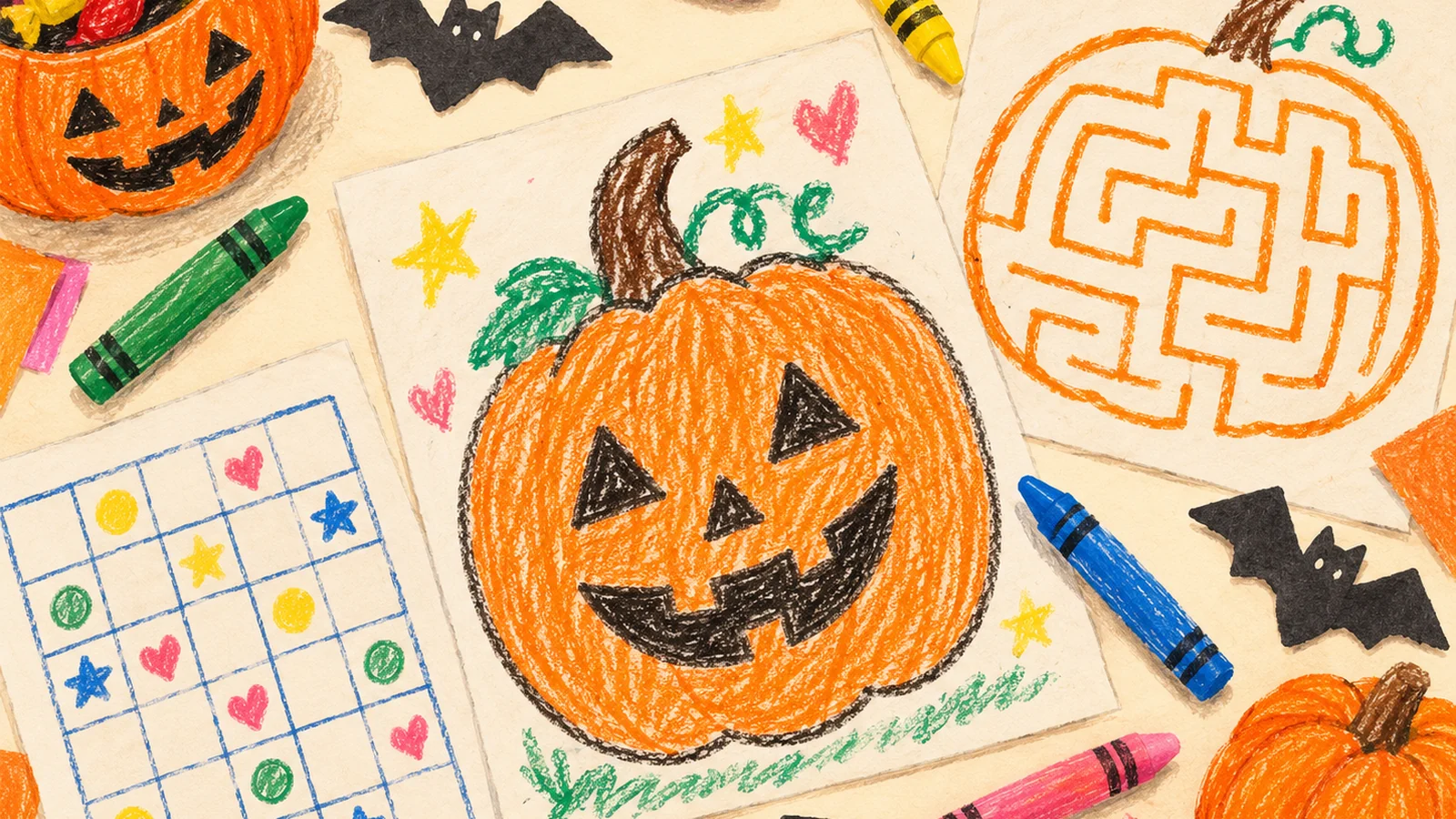
Pumpkin coloring gives early arrivals something to do while you greet families, help children find seats or wait for the rest of the class. Put the pages in the center of the table and let each child choose a design. Orange pumpkins are familiar, but purple, green and striped pumpkins are welcome too. There is no need for everyone to finish the same picture.
Choose a pumpkin-shaped maze with a clear starting point and a visible finish. Younger children can trace the route with a finger before using a crayon or pencil, while older kids can work independently. If a child gets stuck, ask them to find a path that does not end at a wall rather than drawing the solution for them.
For children who finish early, offer another picture from Cute coloring pages or a second maze. Having an extra choice ready is better than asking a five-year-old to sit quietly while everyone else catches up. Keep the goal simple: enjoy the activity, not race to finish first.
Print a Halloween word search for the next round
A Halloween word search gives children a quieter challenge after coloring and maze-solving. Use familiar words such as pumpkin, ghost, bat, candy, witch and spider. Younger children may recognize the pictures or letters but need help finding whole words, while older children can scan rows and columns on their own.
For preschoolers and early kindergarten students, choose a page with a short word list and large letters. You can read each word aloud, ask the child to find its first letter, and help them follow the letters across the grid. Children who are still learning to read can take part without having to complete the entire puzzle.
First graders and older children may enjoy a more challenging printable with longer words. Let them work alone or in pairs, but avoid turning the activity into a race unless the group enjoys friendly competition. If someone finishes quickly, ask them to circle a favorite Halloween word and explain why they chose it.
Run a scavenger hunt without turning the house upside down
The scavenger hunt is the most active part of the party, so set the boundaries before handing out the checklists. Choose a few rooms or one classroom area, and hide or display ordinary Halloween objects where children can see them safely. A paper bat on a wall, a small pumpkin on a shelf and an orange paper spider near a doorway can all count.
Give each child a checklist with simple items to find, or put children in pairs so early readers can help younger partners. You can use pictures instead of written clues for preschoolers. Ask children to point to each object or mark it on the page rather than collecting decorations and carrying them around.
Set a 15 to 20 minute limit and explain that nobody should open cupboards, climb on furniture or enter rooms outside the play area. In a classroom, keep the search within the room or a designated hallway. If you want a ready-made starting point, the Scavenger hunt for kids page can help you plan a printable version that fits your space.
When time is up, gather everyone and ask which item was hardest to spot. Children who did not find every object still get to join the conversation. The hunt should reward careful looking, not speed.
Finish with trivia and would-you-rather questions
Bring the children back together for Halloween trivia. Prepare about eight to ten questions and read them aloud, giving everyone a few seconds to think before answering. Use familiar topics such as pumpkins, costumes, bats and traditional Halloween decorations. For younger children, offer two possible answers or let them answer as a group.
Keep the questions playful rather than testing obscure facts. You might ask which vegetable is commonly carved into a jack-o'-lantern or which animal is known for hanging upside down. Accept reasonable answers and explain unfamiliar words briefly. If a question stalls the group, give a hint and move on.
Would-you-rather questions make a relaxed final game because children can join in even if reading is difficult. Try questions such as, "Would you rather wear a friendly ghost costume or a giant pumpkin costume?" or "Would you rather visit a haunted castle with friendly bats or a spooky forest full of glowing pumpkins?" Ask children to explain their choices, but let anyone pass if they do not want to speak.
You can find more prompts on Would you rather questions for kids. Choose questions that are silly and suitable for the ages in your group, then finish by asking each child to name the activity they liked best. Keep a little time for coats, bags and cleanup instead of letting the final game run right to the last minute.
Questions parents ask
What are the best Halloween activities for kids at a party?
Combine pumpkin coloring, a simple maze, a Halloween word search, a scavenger hunt and a few spoken games. This mix gives children time to create, solve puzzles and move around.
What Halloween printables should I prepare for each child?
Print one coloring page, one maze and one word search per child. Prepare a scavenger hunt checklist for each child or pair, then keep trivia and would-you-rather questions on a shared sheet for the group.
How do I adapt Halloween classroom activities for preschoolers?
Use coloring pages with large spaces, mazes with short routes and scavenger hunt clues based on pictures. Read word searches and game questions aloud, and let children work with a partner when they need help.
More from the blog
All articles Mandala coloring pages for kids: a calm 20-minute breakUse mandala coloring pages for kids to create a calm 20-minute break after school, with simple color rules and tips for choosing designs.
 Name coloring pages: 8 fun ways to use themTry eight easy ways to use name coloring pages at home or school, from birthday place cards and cubby labels to tracing practice and reusable activities.
 Benefits of coloring for kids, by age and skillLearn the benefits of coloring for kids at each age, with practical page ideas for grip, pencil control, color choices, patterns and shading.