Games7 min read
Restaurant activities for kids: what to print before you go
Keep kids busy at a restaurant with four easy printables, simple packing tips, and age-friendly ideas for toddlers and older children.
 By the 123arc teamPublished Oct 23, 2026
Contents
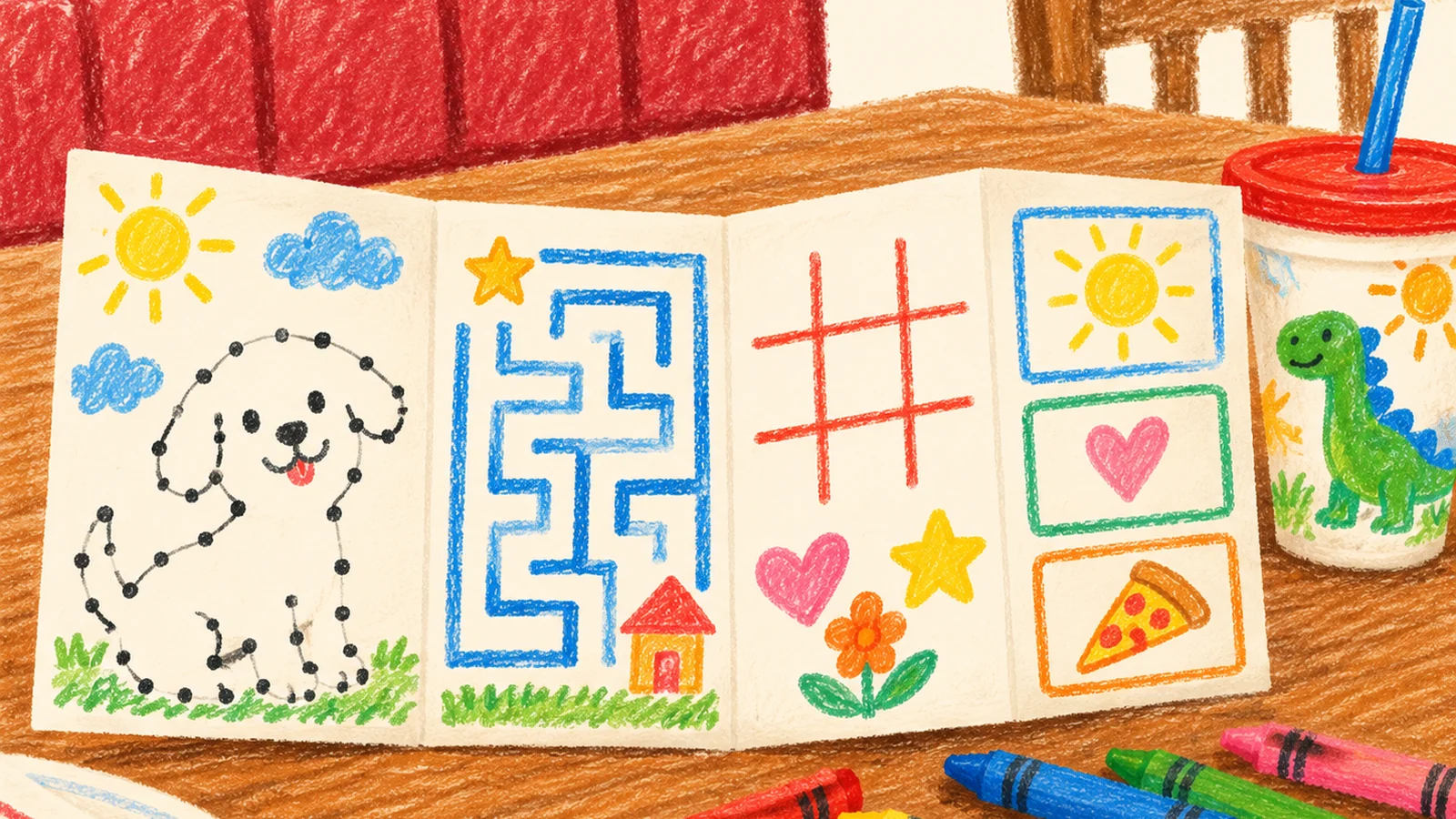
The easiest way to keep kids busy at a restaurant is to bring a few small paper activities they can start while waiting for food. Print a 10-dot dot to dot, a small maze, a would-you-rather card, and a tic-tac-toe sheet, then fold them into your bag with a handful of crayons.
This plan works well for families with children ages 3 to 10, but you can adapt it for younger siblings, too. You do not need a tablet full of games or a bulky activity bag. A little paper, a short game, and a sensible plan for the wait can make eating out less stressful for everyone.
Print four small activities before you leave
You do not need a whole packet of worksheets. Four small activities give you enough choice without turning your restaurant bag into a traveling classroom. Print them on regular paper, cut the pages down if needed, and fold everything into a single envelope.
Start with a 10-dot dot to dot. A young child can join the dots with help, while an older child can work independently and color the picture afterward. The dot to dot printables collection is a useful place to find a simple page. Choose a short puzzle rather than one that fills an entire sheet with tiny numbers.
Add a small maze with a clear start and finish. Mazes give children something to concentrate on while you look at the menu or wait for drinks. Pick an easy one for a preschooler, and save harder paths for school-age kids who enjoy figuring things out.
Your last two activities should need almost no explanation. A would-you-rather card gives everyone a question to answer, and tic-tac-toe works with two players or a child playing against a parent. If your child loses interest in one, move to the next instead of insisting that every page gets finished.
- One 10-dot dot to dot
- One small maze
- One would-you-rather question card
- One tic-tac-toe sheet
Pack the printables so they are ready at the table
Put the folded pages in an envelope or a slim zip pouch before you leave home. Keep them near the top of your bag, not underneath spare clothes, water bottles, and everything else you brought for the day. When the wait starts, you want to reach in and hand over a page in seconds.
Crayons need a little thought. Round crayons roll off restaurant tables and disappear under chairs, so choose short, chunky crayons with flatter sides when you can. A small washable crayon set is easier to manage than a full box with dozens of colors. Bring just three or four.
I would skip markers, glitter pens, scissors, glue, and anything that needs a separate pile of pieces. Restaurant tables are shared spaces, and servers need room to set down hot plates. Paper activities work best when your child can use them within a small patch of table and pack them away quickly.
A clipboard or thin piece of cardboard gives children a firm surface if the table is uneven or crowded. It is optional, though. For a short meal, a few folded sheets and crayons are usually enough.
Time the activities around the meal
When should you hand over the first page? Wait until your child has settled into the seat and you have ordered, unless the restaurant is already running behind. Giving every activity away at once can leave you with nothing new when the food is still ten minutes away.
Try one page at a time. The dot to dot might cover the first part of the wait, and the maze can come out when your child finishes. Save the would-you-rather card for a moment when you want to talk together, such as while everyone waits for the main course.
The timing will depend on the child and the meal. Some children can sit with a puzzle for ten minutes; others finish it in two and need a change. Watch for signs that the page is no longer helping. If your child starts poking a sibling with a crayon or turning the paper into a fan, switch activities or take a short break.
Keep the food itself in mind. Put the paper away when plates arrive, especially if the table is small or the meal is hot and messy. You can bring the pages back out after eating if the adults are still finishing up.
Adjust the plan for a 2 year old
A 2 year old probably will not follow a numbered dot to dot or stay with a maze for long. That is normal. At this age, the goal is a short, safe activity that gives little hands something to do while you stay close.
Bring one sheet with a large, familiar picture and a few chunky crayons suitable for your child's age. You can find simple pictures in easy coloring pages for toddlers and preschoolers. Point to an animal or object, name its color, and let your child make marks wherever they like. The page does not need to look finished.
You can also play a quiet pointing game without printing anything. Ask your toddler to find a spoon, a cup, a light, or something red. Let them point rather than reach across the table. Another option is to talk about the pictures on the menu while you wait.
Keep small items, loose game pieces, and anything your child might put in their mouth out of reach. Stay close while they use crayons, and check the age guidance on the art supplies. If your toddler is tired or hungry, paper alone may not be enough. A familiar snack, a drink when appropriate, and a brief walk with an adult may help more than another activity.
Use quiet games when coloring stops working
Some children love drawing but get restless if every activity asks them to stay inside the lines. That is where a spoken game helps. You can use the would-you-rather card as a starting point, then ask questions of your own while keeping voices low enough for the people at nearby tables.
Try questions with two clear choices: Would you rather have a pet rabbit or a pet turtle? Would you rather eat breakfast for dinner or dinner for breakfast? Let each person explain their answer if they want to. There is no score to keep, and a child who is not ready to explain can simply point to a choice.
For children who enjoy words, a quick guessing game can stretch the wait without taking up any space. Think of an animal and let your child ask yes-or-no questions. For younger children, reverse the game and give clues such as 'It has four legs and says meow.' Keep it light, and stop before the questions turn into a test.
If your child wants a fresh activity for the next outing, print a few cute coloring pages and rotate them with the maze and dot to dot. A new picture can feel special without requiring a new toy. You can also ask your child to help choose which pages go into the envelope before the next meal.
Set realistic expectations for eating out
Even a well-packed activity kit will not make every restaurant visit peaceful. A child may be overtired, the food may take longer than expected, or the table may be too crowded for paper. Think of the printables as a useful backup, not a promise that your child will sit still for the entire meal.
Choose a restaurant time that fits your family's usual eating routine when you have that option. A hungry child often has less patience for puzzles, so ordering promptly and asking about expected wait times can help you decide when to bring out an activity. If the restaurant has a long delay, do not save every page for later just to stick to a plan.
Set a simple boundary before you sit down. Explain that crayons stay on the paper, voices stay at a comfortable level, and activities go away when food arrives. Young children may need reminders, but clear expectations give them something specific to follow.
Most of all, keep your kit small enough that you will actually bring it. Four printed activities, a few crayons, and one spoken game are plenty for an ordinary meal. Put the envelope back in your bag when you get home, and it will be ready for the next restaurant visit.
Questions parents ask
How do I keep kids busy at a restaurant without a screen?
Bring a short dot to dot, a simple maze, and a few crayons, then save a spoken guessing game for later. Offer one activity at a time so your child has something new to try during the wait.
What are good restaurant activities for a 2 year old?
Try a large picture to color, a pointing game, or a quiet conversation about things your child can see. Use age-appropriate supplies, supervise closely, and keep small pieces out of reach.
What should I print for kids before going out to eat?
Print one short dot to dot, one easy maze, a would-you-rather card, and a tic-tac-toe sheet. Fold the pages into a small envelope and pack a few crayons that will not roll easily.
More from the blog
All articles Road trip activities for kids that fit on a clipboardKeep kids busy on long drives with printable scavenger hunts, trivia, dot to dots and mazes, plus a simple plan for screen time and breaks.
 Fall activities for kids with leaves, apples and pumpkinsPlan an easy fall afternoon with a leaf walk, coloring pages, apple counting, pumpkin mazes, a fall word search and a nature scavenger hunt.
 Summer activities for kids: 10 weeks of printable funBeat summer boredom with 10 themed printable activity packs for kids, each with a coloring page, word search, maze and scavenger hunt.