Games8 min read
Road trip activities for kids that fit on a clipboard
Keep kids busy on long drives with printable scavenger hunts, trivia, dot to dots and mazes, plus a simple plan for screen time and breaks.
 By the 123arc teamPublished Oct 23, 2026
Contents
- Build a road trip clipboard for each child
- Play a car ride scavenger hunt
- Keep the whole car playing with would-you-rather questions
- Add trivia about the states you pass through
- Choose dot to dots, mazes and coloring pages by age
- Plan what to print for each hour of driving
- Set a screen rule before you leave
- Questions parents ask
The best road trip activities for kids are easy to carry, simple to start and fun enough to hold their attention between stops. A clipboard with a few printed games, a pencil and a small stack of fresh pages gives your child something to do without filling the car with toys.
If you are planning a family drive with preschoolers, elementary school kids or siblings of different ages, prepare a mix of quiet paper activities and games everyone can play aloud. You do not need a new activity for every mile. A little variety and a plan for when to hand out each page will get you through the drive with less fuss.
Build a road trip clipboard for each child
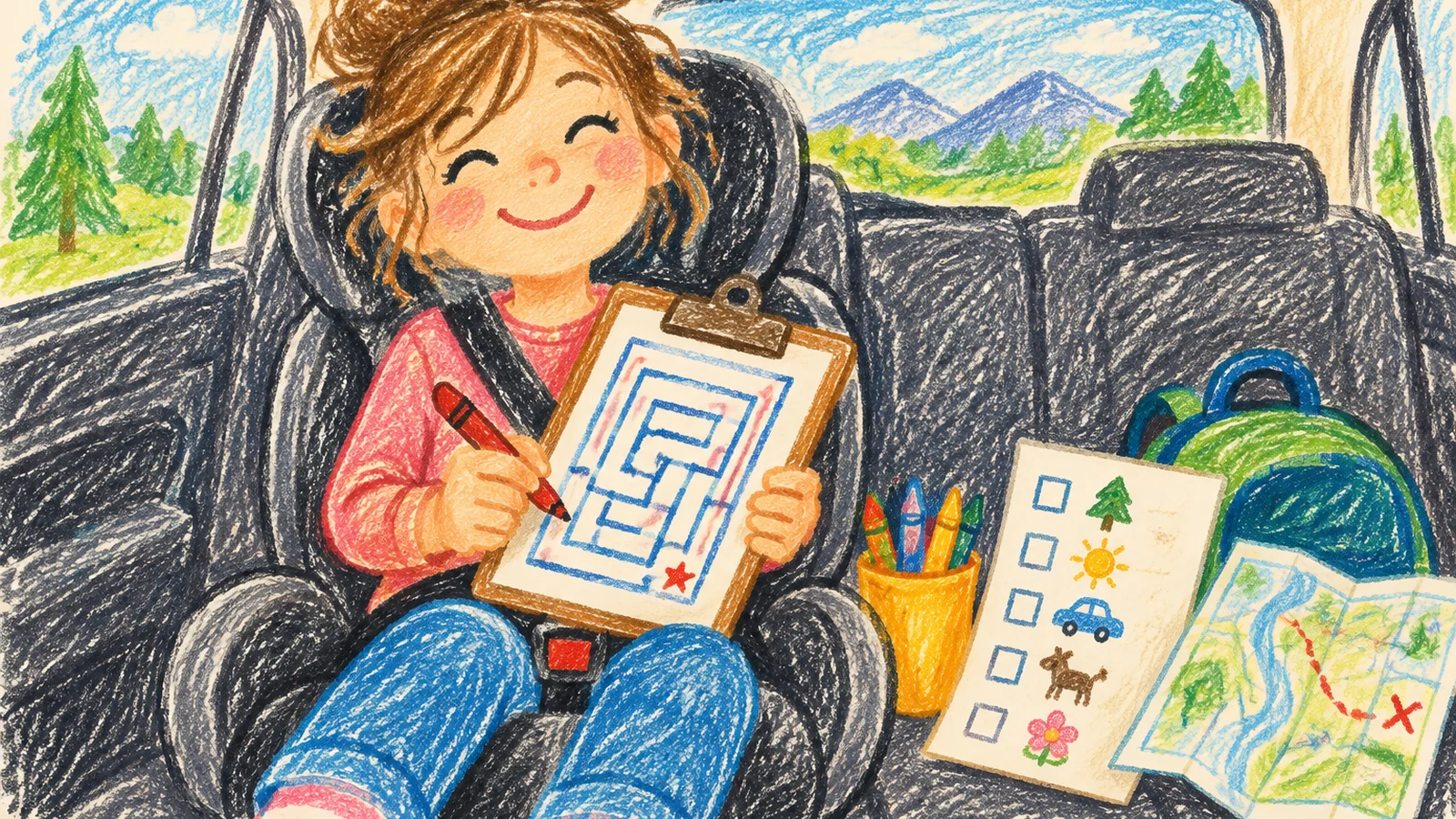
Start with a sturdy clipboard that holds standard letter-size paper. Add a pencil with an eraser, a few crayons for younger children and a folder or large envelope for finished pages. If your child likes stickers, tuck a few into the folder as small rewards for completing activities.
Keep the first page easy. A simple coloring sheet or picture scavenger hunt helps a child settle in before you ask them to follow a maze or answer questions. For preschoolers, choose large pictures and wide spaces. Older kids can handle word games, numbered puzzles and written challenges.
I would prepare one small packet for each hour of driving rather than handing over the entire stack at once. Put the pages in order, then keep the next packet within reach of an adult. When a child announces that they are bored, you have another activity ready instead of having to search through a bag.
For younger children, check that crayons and pencils are safe to use in their seats, and avoid hard objects that could become dangerous during a sudden stop. An adult should handle any activity that requires looking for objects outside the car.
- One clipboard per child, if space allows
- Three to five activity pages per hour of driving
- A pencil, eraser and a few crayons
- An envelope for completed pages
- A small reserve of activities for unexpected delays
Play a car ride scavenger hunt
A car scavenger hunt gives children a reason to look out the window and notice the places you pass. Make a checklist of things they might see, such as a red barn, a bridge, a gas station, a road sign, a tractor, a water tower or a dog in another vehicle. Children can check off each item when they spot it.
For a printable version, leave a small box beside every picture or word. Younger kids can mark the box with a crayon, while readers can work through a written list. You can also create separate lists for city streets, country roads and highway travel, so the activity still feels possible when the scenery changes.
Try a car ride game for kids that does not require every item to be found. Give one point for each sighting, or ask children to find five different colors, three kinds of vehicles or two bridges. If you have several children, let them use different lists so they are not arguing over who spotted something first.
Use the Scavenger hunt for kids page to prepare a hunt before leaving home. Keep the driver out of the game. Passengers can call out clues, but the driver should stay focused on the road.
Keep the whole car playing with would-you-rather questions
Paper games are useful when the scenery gets repetitive or a child needs a break from looking out the window. Would-you-rather questions work well because nobody needs a board, pieces or a place to write. One person reads a question, everyone picks an answer, and each player can explain their choice if they want to.
Keep the questions silly and suitable for the youngest person in the car. Would you rather ride in a submarine or a hot-air balloon? Would you rather eat pancakes for dinner or pizza for breakfast? Would you rather have a pet penguin or a tiny dragon? Questions like these can lead to funny conversations without putting anyone on the spot.
Print the questions on cards and cut them out before the trip. An adult can keep the cards in a pouch and read one whenever the car needs a new game. If you prefer a page that stays together, print a list and let a passenger choose the next question.
The [Would you rather questions for kids](https://123arc.com/would-you-rather-questions-for-kids/) collection is a good place to find prompts for the family. For children who do not like speaking in front of everyone, let them point to an answer or simply listen until they feel ready to join in.
Add trivia about the states you pass through
State trivia turns a long drive into a geography game. Before leaving, print a few questions about your destination and the states along your route. You might ask children to identify a state by its outline, name its capital or guess which state comes next on the map. For younger kids, use picture clues or give them two possible answers.
You do not need to prepare a full quiz for every state. Five questions per state can be plenty, especially if the children are still learning to read. Older kids can write their answers on the clipboard and check them during a rest stop. For a mixed-age group, ask an easier question first, then add a bonus question for children who want a challenge.
Check the answers before printing, particularly if you include state capitals, state symbols or historical facts. Keep a small answer sheet for the adult rather than printing the answers directly beside every question. If you are crossing several states, a simple route map can help children connect the questions to the places outside the window.
Keep the tone playful. If nobody knows an answer, tell the children and look it up when the car is parked. The point is to give them something interesting to think about, not turn the trip into a test.
Choose dot to dots, mazes and coloring pages by age
Paper puzzles are handy when children want to work quietly on their own. Dot to dots give them a clear goal, while mazes ask them to find a route from a start point to a finish. Coloring pages are a good choice for children who would rather make something than solve a puzzle.
For ages three and four, choose pictures with large spaces, short dot sequences and easy paths. A child who is just learning to hold a crayon may be happy coloring one animal for ten minutes. Children around five to seven often enjoy simple mazes, alphabet puzzles and dot to dots that reveal a familiar picture. Older children can try harder mazes or add a time challenge if they enjoy competition.
Print a mixture of easy and slightly harder pages, because the right level depends on the child and how tired they are. A maze that feels fun at the start of the drive may be frustrating after lunch. Keep a few simple pages for those moments.
Browse Dot to dot printables and [Printable mazes for kids](https://123arc.com/printable-mazes/) when building your packet. Add a few coloring sheets for variety, and avoid pages with tiny details that are difficult to manage on a moving trip.
Plan what to print for each hour of driving
For every hour on the road, pack three to five pages rather than expecting a child to complete them all. Some children finish a puzzle in two minutes. Others spend half an hour coloring one picture. Your packet is a menu of choices, not a schedule they have to follow.
For the first hour, start with a scavenger hunt and an easy coloring page. During the next hour, bring out a would-you-rather game or a few state trivia questions. Save dot to dots and mazes for a quieter stretch when the children are ready to focus. After a meal or rest stop, offer a fresh page instead of insisting they finish an old one.
Here is a sample packet for a three-hour drive. Adjust the number of pages to your child's age and attention span.
- Hour one: one scavenger hunt, one coloring page and one spare activity
- Hour two: five would-you-rather questions, two state trivia pages and one spare activity
- Hour three: two dot to dots, two mazes and one coloring page
Set a screen rule before you leave
Screens can be useful on a long trip, especially when children are tired, carsick or ready for a break from paper games. The trouble usually starts when everyone has a different idea of when a device should come out. Agree on a simple rule at home, before the first argument begins.
One option is to begin with paper activities and family games, then save screen time for a planned part of the drive. You might use a device after lunch or during the final stretch. Another family may prefer screens during the longest highway section. Choose a rule that suits your children and the length of your trip, then explain it clearly.
Tell children what they can do when they finish a page. They might choose another sheet, listen to an audiobook, play an oral guessing game or rest. A finished worksheet should not automatically mean that a screen is available, unless that is the rule you agreed on.
Keep devices and activity supplies within reach of an adult, and stop somewhere safe if a child needs help with a puzzle or feels unwell. You do not have to fill every quiet minute. Sometimes a snack, a stretch at a rest stop or a little time looking out the window is the best next activity.
Questions parents ask
What are the best road trip activities for kids?
Try a car scavenger hunt, would-you-rather questions, state trivia, coloring pages, dot to dots and simple mazes. Pack a mix of quiet activities and games the whole family can play aloud.
How do I keep kids busy in the car without screens?
Give each child a clipboard with a few age-appropriate printables, pencils and crayons. Add spoken games, audiobooks and planned rest stops so the children have other choices when they get bored.
How many road trip printables should I pack per hour?
Start with three to five pages per child for each hour of driving. Treat them as options rather than required tasks, and pack extra easy pages for tired moments or unexpected delays.
More from the blog
All articles Fall activities for kids with leaves, apples and pumpkinsPlan an easy fall afternoon with a leaf walk, coloring pages, apple counting, pumpkin mazes, a fall word search and a nature scavenger hunt.
 Summer activities for kids: 10 weeks of printable funBeat summer boredom with 10 themed printable activity packs for kids, each with a coloring page, word search, maze and scavenger hunt.
 Christmas activities for kids while dinner cooksKeep kids busy while Christmas dinner cooks with easy printables, coloring pages, a tree maze, word searches, scavenger hunts and family trivia.