Games7 min read
Scavenger hunt ideas for kids: 12 fun lists to try
Try 12 scavenger hunts for kids with ready-to-use lists for home, outside, holidays and parties, plus easy rules for preschoolers and older kids.
 By the 123arc teamPublished Oct 11, 2026
Contents
- Indoor scavenger hunts for home and rainy days
- Outdoor scavenger hunts for the backyard and nature walks
- Scavenger hunts for the beach, car and neighborhood
- Halloween and Christmas scavenger hunt lists
- Alphabet, color and birthday party scavenger hunts
- Simple rules for little kids and timed hunts for older kids
- Questions parents ask
These scavenger hunt ideas for kids give you 12 ready-to-use lists for home, outdoor play, car rides, holidays and birthday parties. Each hunt has 8 to 10 things to find, with simple rules for younger children and a timed challenge for older kids.
You can set up most of these hunts in about 5 minutes with a piece of paper and a pencil. Some work for preschoolers who cannot read yet, while others give kids ages 7 to 10 a proper challenge. You do not need prizes, fancy supplies or an afternoon of preparation.
Indoor scavenger hunts for home and rainy days
Start with rooms your child already knows. For an indoor hunt, kids can point to an object instead of collecting it. That keeps the couch cushions in place and saves you from finding eight random household objects on the kitchen counter.
Indoor hunt list: something soft, a book with an animal, a round object, something blue, a wooden item, a sock, something that makes noise, a family photograph and something smaller than your hand.
Rainy day hunt list: a blanket, a favorite toy, a spoon, something with stripes, a pillow, a paper bag, something yellow, a stuffed animal and an object that begins with B.
For a rainy afternoon, I would hide two or three objects in plain sight to make the familiar rooms feel different. Keep anything breakable or sharp off the list. You can also use the Indoor scavenger hunt printable at /indoor-scavenger-hunt/ when you want a sheet children can check off themselves.
Outdoor scavenger hunts for the backyard and nature walks
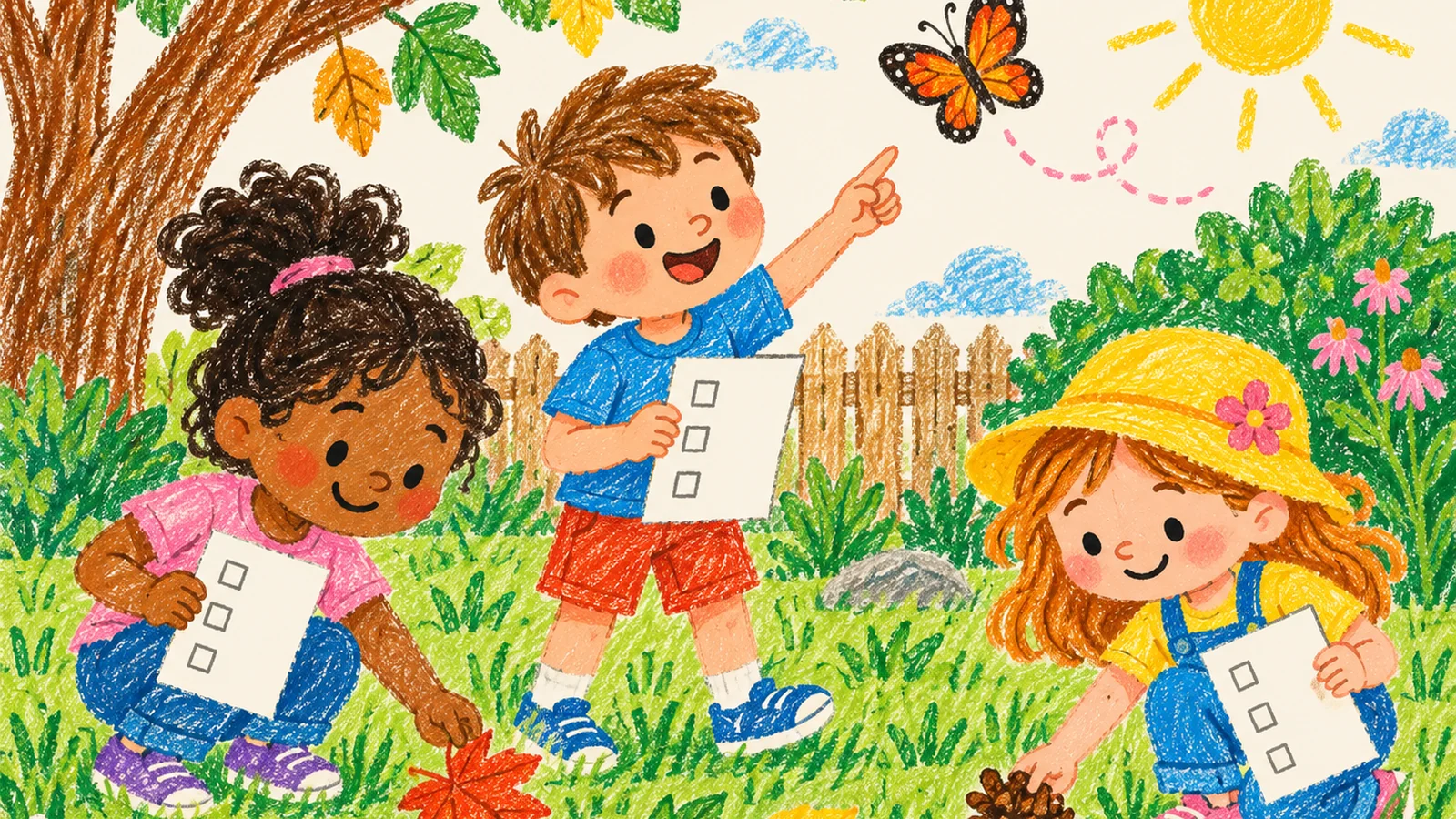
Outdoor scavenger hunt ideas work best when children can look closely without having to pull plants apart or collect living creatures. Give each child a pencil and ask them to check off what they see. For younger kids, draw a quick picture beside each item.
Backyard hunt list: a green leaf, a small stone, a flower, a twig, an ant, a bird, something rough, something smooth and a shadow shaped like something funny.
Nature walk hunt list: a feather, tree bark, a fallen leaf, a pinecone, moss, a flying insect, a bird call, a fork in a path and something with an interesting pattern. Some items depend on your area, so let children substitute another natural object if something is missing.
The best rule here is to look first and leave things where they belong. A child can sketch a flower instead of picking it. For more outdoor activities, the Outdoor scavenger hunt printable at /outdoor-scavenger-hunt/ gives you another starting point.
Scavenger hunts for the beach, car and neighborhood
These hunts turn ordinary trips into something children pay attention to. A beach hunt keeps little hands busy near your spot, while a car hunt can make a long stretch of road feel shorter. An adult should always handle the list if a child cannot safely look and write at the same time.
Beach hunt list: a smooth pebble, a shell, seaweed, a bird, footprints in sand, a piece of driftwood, a wave with white foam, something heart-shaped and three different sand colors. Children should leave live shells and wildlife alone.
Car ride hunt list: a red car, a truck, a stop sign, a bicycle, a bridge, a gas station, a dog in a vehicle, a yellow building and a road sign with a number. Give passengers the job of spotting. Drivers should keep their eyes on the road.
Neighborhood hunt list: a mailbox, a house number with 3, a bicycle, a tree taller than a house, a garden decoration, a bench, a bird, a painted front door and a street sign.
Going with a mixed-age group? Pair an older reader with a younger spotter. You can also turn the neighborhood list into a walk around one block rather than trying to cover the whole area.
Halloween and Christmas scavenger hunt lists
Holiday hunts are especially easy because decorations give children plenty to notice. You can do these indoors, around your neighborhood or during a holiday gathering. Set boundaries first, and tell children not to enter anyone else's yard.
Halloween hunt list: a pumpkin, a paper bat, a spider decoration, a witch hat, a black cat picture, something orange, a ghost decoration, a skeleton and a porch light.
Christmas hunt list: a star, a string of lights, a candy cane decoration, a stocking, a wrapped present, a snowflake, a reindeer picture, something green and an ornament shaped like an animal.
For Halloween, try a hunt before trick-or-treating while everyone is still excited and has energy. At Christmas, a short indoor hunt can occupy children while dinner is being prepared. Both lists can work as picture hunts for preschoolers.
You can find another seasonal activity using the Halloween scavenger hunt printable at /halloween-scavenger-hunt/. Keep the hunt short enough that children still want to play again next year.
Alphabet, color and birthday party scavenger hunts
These three hunts give you a little more room to adapt the difficulty. Children who are learning letters can hunt for familiar sounds, while older kids can search for unusual examples. For a birthday party, use teams so nobody is left searching alone.
Alphabet hunt list: something beginning with A, a B object, a C object, something with D on its label, an E object, something beginning with F, a G object, an H object and an item with the letter S on it. Accept sensible answers, including an apple picture for A.
Color hunt list: something red, orange, yellow, green, blue, purple, pink, brown, black and white. Ask children to find a different object for each color, rather than using the same multicolored toy ten times.
Birthday party hunt list: a balloon, a party hat, a wrapped gift, a paper napkin, a birthday card, a candle, a ribbon, a decoration with a number, something that matches the party theme and an object hidden by the host.
A birthday scavenger hunt for kids works well with groups of two or three. Give each team the same list and have everyone return to one meeting spot. Skip racing for a prize if you have very young guests. Completing the hunt together is plenty.
Simple rules for little kids and timed hunts for older kids
For ages 3 to 5, use just four or five items from any scavenger hunt list. Add drawings beside the words, stay nearby and let children point to objects instead of carrying them. A 10-minute hunt is usually easier to manage than a long search with complicated clues.
For ages 6 to 8, try the full list of eight to ten objects. Let children read the clues themselves, cross off their finds and ask for one hint if they get stuck. If a clue is too difficult, allow a reasonable substitute rather than turning the game into a test.
Want to make it harder for ages 8 to 10? Set a timer for 12 minutes and give one point for each item found. Add two bonus points when a child can describe an object without naming it and a teammate guesses correctly. Set the search area before starting, and stop the clock when everyone returns.
You can also run a cooperative version where the entire group tries to find everything before time runs out. This is my pick for siblings with different ages because the older child can read while the younger one spots objects.
Use the Scavenger hunt for kids page at /scavenger-hunt-for-kids/ when you want more printable options. For any hunt, tell children which rooms or outdoor areas are allowed, whether they may pick things up and what to do if they cannot find an item. Clear rules make the game much easier to run.
Questions parents ask
How many items should a kids scavenger hunt have?
Use four or five items for preschoolers and eight to ten for elementary-age children. You can shorten any of the lists if your child starts losing interest.
How do you do a scavenger hunt for kids who cannot read?
Draw or print pictures of the objects and have children point to each one as they find it. Stay with them and give simple clues when needed.
How long should a scavenger hunt last?
Try 10 minutes for children ages 3 to 5 and about 15 to 20 minutes for older kids. A timed version works best when every item is within the agreed search area.
More from the blog
All articles 80 trivia questions for kids with answers by topicTry 80 trivia questions for kids across eight fun topics, with answers included and simple rules for hosting a family or classroom quiz.
 60 riddles for kids with answers from easy to hardTry 60 fun riddles for kids with answers, sorted by age and difficulty. Perfect for family game nights, classroom breaks and car rides.
 100 would you rather questions for kids to make everyone laughTry 100 funny would you rather questions for kids, with silly, animal, food, school and family choices for ages 4 to 10 at home or in class.