Coloring9 min read
Dinosaur activities for kids: a five-day printable dino week
Plan five days of dinosaur fun with coloring pages, dot to dots, word searches, trivia and a backyard fossil hunt for kids ages 3 to 8.
 By the 123arc teamPublished Oct 30, 2026
Contents
Dinosaur activities for kids can fill an entire week with fun learning at home, using just a few printable pages and things you already have around the house. Try dinosaur coloring pages on Monday, a dot to dot on Tuesday, a word search on Wednesday, a trivia quiz on Thursday and a backyard fossil hunt on Friday.
This five-day dinosaur week is designed for children ages 3 to 8, with easier options for preschoolers and extra challenges for older kids. You do not need a dinosaur-themed party or a cupboard full of craft supplies. Set aside 15 to 25 minutes each day, print the activity you need and let your child's interest decide how long you continue.
Before you start your dinosaur week
Pick a small collection of dinosaur printables before Monday morning. You will need dinosaur pictures to color, one dot to dot, a word search and a few questions for the quiz. For Friday, gather a small basket, a spoon and some paper for recording the backyard discoveries. A printer, crayons and pencils will cover most of the week.
I would keep the activities short rather than trying to fill an entire afternoon. Young children often enjoy repeating a favorite page, and there is no reason to rush them toward the next day's task. A three-year-old might spend ten minutes coloring one dinosaur, while an eight-year-old may want to add labels, facts or a whole prehistoric scene.
Choose a regular time that suits your family. After breakfast works well for some children, while others are happier with a quiet activity after school. Keep the finished pages together in a folder. By Friday, your child will have a little collection of dinosaur work to look through.
Monday: dinosaur coloring pages with scales
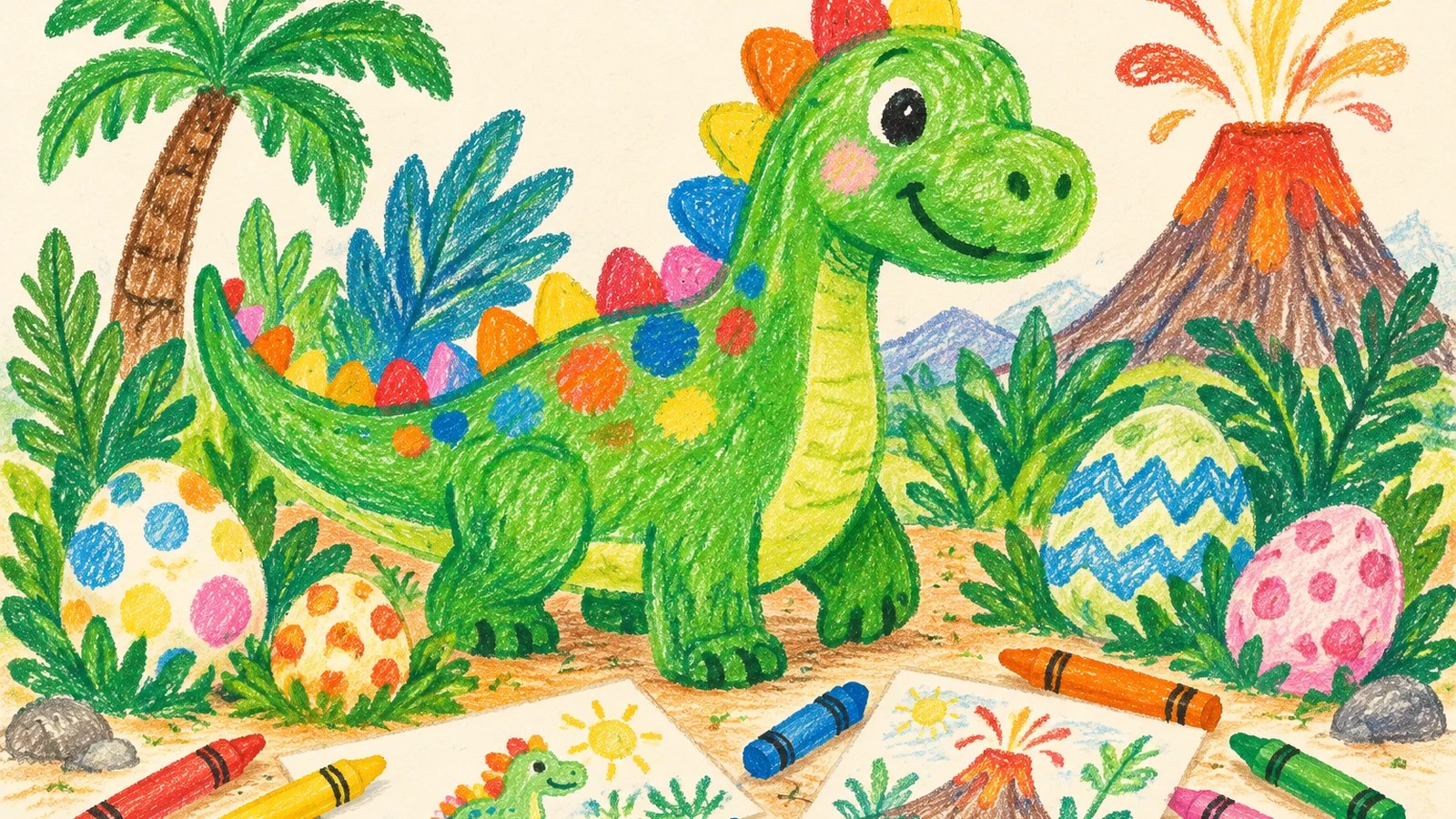
Start the week with dinosaur coloring pages. Give your child a choice of dinosaurs, then invite them to imagine the colors and patterns each animal might have had. Green is an easy starting point, but there is no need to insist that every dinosaur looks the same. Purple scales, orange spots and a blue tail are perfectly welcome in a child's prehistoric world.
For a simple activity, print a large dinosaur outline with plenty of open space. Ask your child to add scales using small circles, curved lines or dots. Younger children can make marks with chunky crayons, while older children can fill the dinosaur's back with repeating patterns. If drawing scales feels difficult, let them use stickers or colored pencil dots instead.
You can find more pictures in the Dinosaur coloring pages collection. For younger children who are still learning to control a crayon, Easy coloring pages for toddlers and preschoolers offers a gentler starting point. Keep the page on a flat surface and let your child work at their own pace.
Try a little conversation while they color. What might this dinosaur eat? Would it walk on two legs or four? Ask your child to give the finished dinosaur a name. A few minutes of talking can turn a quiet coloring session into a lovely bit of pretend play.
Tuesday: follow the dinosaur dot to dot
Tuesday is for connecting the dots. A dinosaur dot to dot gives children a reason to slow down, look carefully and follow a numbered path. Once the lines join up, they can see which dinosaur has been hiding on the page. Leave time for coloring the finished picture, too.
Preschoolers may need a page with fewer numbers and larger spaces between the dots. Sit beside your child and point to the next number if they lose their place. Children ages 6 to 8 can try a longer sequence and complete the activity with less help. If counting is still new, say the numbers aloud together rather than turning the page into a test.
Use the Dot to dot printables collection to find a suitable starting activity. You can also draw a simple dinosaur outline on scrap paper and add numbered dots along its shape if you want to make your own version. Start with the head, continue along the back and tail, then work around the legs.
After the dinosaur appears, ask your child to count how many legs it has. They could add grass, a tree or a volcano in the background. Small additions give older children something extra to do without making the original activity harder for younger siblings.
Wednesday: a dinosaur word search
Midweek brings a dinosaur word search. This is a good activity for children who enjoy spotting letters and finding hidden words. Start with familiar dinosaur names and simple words such as T-REX, FOSSIL, EGG, TAIL and ROAR. For a preschooler, use the words as picture and letter matching practice instead of expecting them to complete a full grid.
Children ages 6 to 8 can search for words independently or work through the puzzle with a sibling. Read each word aloud before they begin. If your child finds a word, ask them to circle it and cross it off a separate list. This gives them a clear place to return to when the grid starts to look busy.
The Word search printable collection is a useful place to find a suitable puzzle. Choose a smaller grid for a first attempt, especially if your child is still getting used to reading. A larger puzzle can wait until they are comfortable looking across rows and columns.
Make the words part of a short conversation. Does your child know what a fossil is? Can they explain what a dinosaur's tail might have been used for? You do not need to turn every answer into a lesson. Let curiosity lead, and help with unfamiliar words when they appear.
Thursday: a dinosaur trivia quiz
Give the pencils a rest on Thursday and play a dinosaur trivia quiz. You can read questions aloud while your child answers, or take turns asking questions. For younger children, offer two possible answers and let them point to their choice. Older children can try answering without hints and explain how they reached their answer.
Keep the questions short and use facts that are easy to talk about. For example, ask whether dinosaurs lived millions of years ago or yesterday, whether a T. rex ate plants or meat, and whether fossils can help us learn about ancient animals. Children often remember a fact better when they get to explain it in their own words.
Here are five questions to get your quiz started:
- What do we call the preserved remains or traces of ancient living things? Fossils.
- Was Tyrannosaurus rex a meat eater or a plant eater? A meat eater.
- Did all dinosaurs eat meat? No, many ate plants.
- What did a dinosaur hatch from? An egg.
- What is the name of the long-necked dinosaur often shown eating leaves from tall trees? Brachiosaurus.
Keep the mood playful. If your child gives an unexpected answer, ask how they imagined it before revealing the answer. You can give one point for each correct response, but there is no need for a winner. Younger children may prefer acting out a dinosaur or making its roar after each question.
Friday: a backyard fossil scavenger hunt
Finish the week outside with a fossil scavenger hunt. Explain that real fossils are remains or traces of ancient life preserved in rock, but today's hunt is a pretend dinosaur discovery. Your child will look for natural objects that resemble things a young paleontologist might notice, such as a leaf with clear veins, a stone with an interesting shape or a small twig that looks like a dinosaur bone.
Write a short list before heading outdoors. Keep the search area safe and familiar, such as your backyard, garden or a nearby patch of grass. Children can carry a small basket and collect only loose objects that are safe to pick up. Leave living plants, insects and anything that belongs to someone else where they are.
Try these five backyard discoveries:
- A leaf with a pattern that looks like scales.
- A small stone that could be a pretend fossil.
- A twig shaped like a dinosaur bone.
- A feather lying on the ground.
- A patch of soil where a dinosaur might have left a footprint.
For children ages 3 to 5, describe each item and help them find something similar. Older children can draw their discoveries or write a short note about where each object was found. You could even press a leaf into modeling clay at home to make a simple impression. Keep the activity focused on looking and observing rather than digging up the garden.
When you return indoors, spread the finds on a table and let your child explain their discoveries. Ask which object looks most like a fossil and why. Take a photograph before putting everything away, especially if your child wants to show someone what the backyard expedition uncovered.
How to adjust the activities for ages 3 to 8
A dinosaur theme preschool week should leave plenty of room for scribbling, counting aloud and pretend play. Children ages 3 to 4 usually do best with large pictures, a few simple instructions and an adult nearby to help. Let them color freely, connect a handful of dots with support and search for objects by shape or color. They do not need to read the dinosaur words themselves to enjoy the activities.
For ages 5 to 6, add simple counting and letter recognition. Ask your child to find a particular letter in the word search, count the dots on a picture or answer a trivia question using a complete sentence. If they are beginning to read, give them time to sound out dinosaur names rather than supplying every answer.
Children ages 7 to 8 may enjoy a little more independence. Give them a harder word search, ask them to write three observations from the fossil hunt or invite them to create their own dinosaur quiz for the family. You could also ask them to draw a dinosaur habitat and add a few labels.
Have siblings of different ages? Give them the same theme but different jobs. A younger child can color a dinosaur while an older one writes its name and makes up a fact about it. That way, everyone takes part without having to complete exactly the same worksheet.
Questions parents ask
What are some easy dinosaur activities for preschoolers?
Start with large dinosaur coloring pages, simple dot to dots and a pretend fossil hunt using leaves and stones. Keep instructions short and let your child explore at their own pace.
How do I plan a dinosaur week for kids?
Choose one short activity for each weekday, such as coloring, dot to dot, a word search, trivia and an outdoor scavenger hunt. Prepare the printables and basic supplies before Monday.
What age are dinosaur printables suitable for?
Many dinosaur printables can be adapted for children ages 3 to 8. Younger children can color and match pictures, while older children can work on puzzles, spelling and written answers.
More from the blog
All articles Pattern activities for kids that make math funTry pattern activities for kids that teach repeating sequences, symmetry and tessellations through coloring, drawing and simple questions.
 40 brain teasers for kids with answers to try togetherTry 40 brain teasers for kids with answers, including number challenges, word puzzles, patterns and lateral-thinking riddles for home or school.
 75 fun facts for kids that are surprising and trueExplore 75 fun facts for kids about animals, space, the human body, food, oceans, weather and history, plus ideas for family trivia night.