Puzzles8 min read
Dot to dot for preschoolers makes five minutes count
See how dot to dot pages help kids practice numbers, pencil control, and planning, with simple ways to choose the right page for each age.
 By the 123arc teamPublished Oct 12, 2026
Contents
Dot to dot for preschoolers turns five minutes with a pencil into practice with number order, hand control, and visual planning. Children follow numbered dots to complete a picture, and each small line gives them a reason to look carefully, choose their next move, and keep going.
If you have a 3, 4, or 5 year old who gets restless during worksheets, connect the dots is worth trying. You need one printed page, a pencil or crayon, and a place to sit. Some children finish in three minutes, while others spend ten minutes carefully finding every number. Both are fine. The goal is a little useful practice without making your kitchen table feel like another classroom.
Three skills hiding inside one little picture
Watch a child connect five dots and you will see several things happening. They find a number, move their pencil toward it, stop at the dot, and search for the next one. That repeated routine is why connect the dots benefits go beyond finishing a cute picture. Every line has a small job.
First comes number recognition. A child who can count aloud to ten may still need practice finding a printed 6 among other numbers. Dot to dot pages give those numbers a purpose. Instead of pointing to random digits on a worksheet, your child is looking for the next one to make a picture appear.
Then there is pencil control. Moving a crayon between two dots asks children to guide their hands toward a target. Short lines are easier than long ones, especially for a child still learning how to hold a writing tool. They also practice stopping their pencil rather than scribbling across the entire page.
Visual planning matters too. Your child needs to search the page, find the next dot, and decide where to move. You do not have to teach those words. Just watch what happens when they find number 7 across the page and carefully draw a line toward it.
How many dots should a child connect at each age?
The number of dots can make or break the activity. A page with 50 tiny numbers might look fun to an adult, but a 3 year old could lose interest before reaching number 8. I would start with fewer dots than you think your child can manage, then increase the count once they are comfortable.
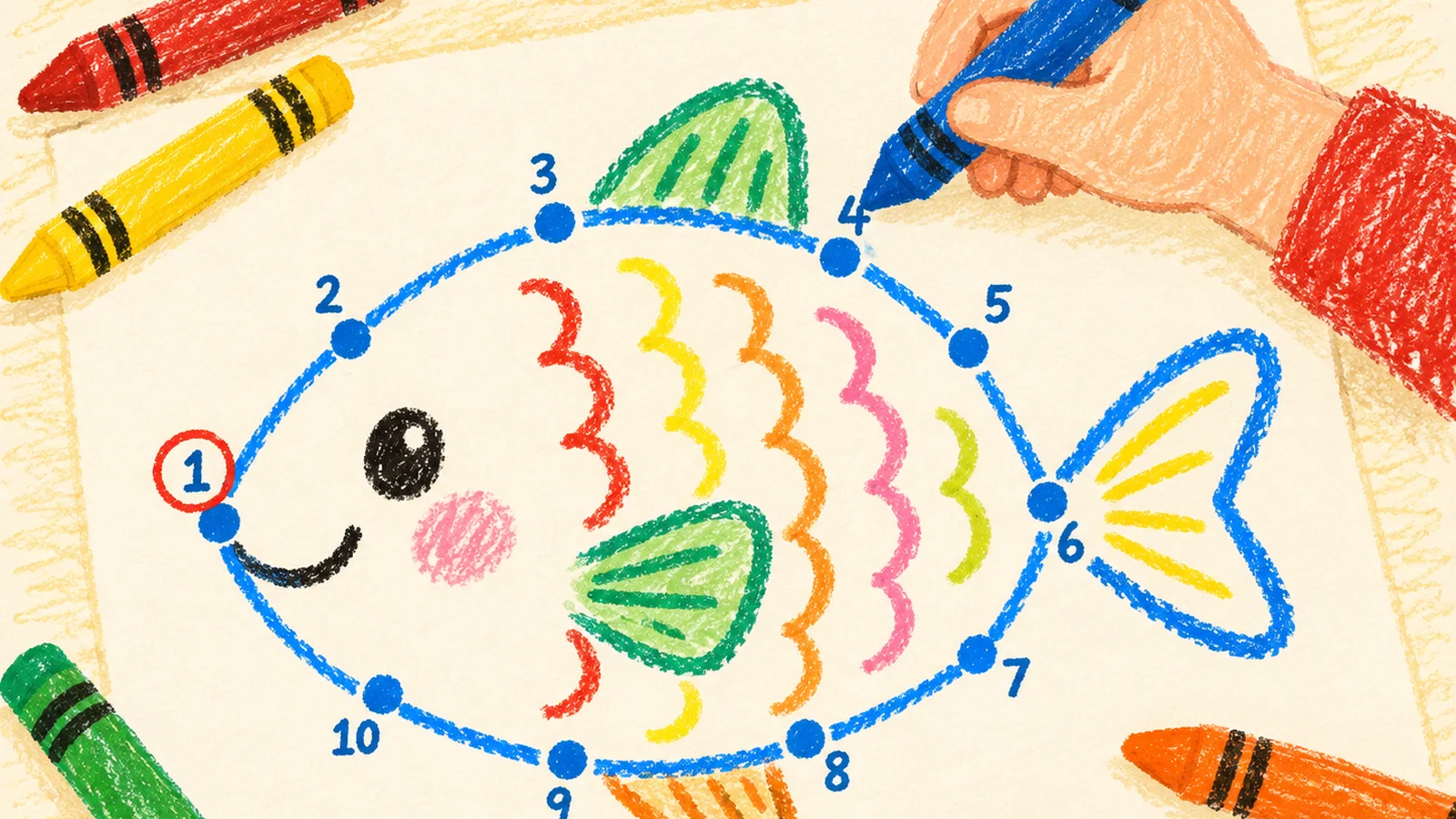
At age 3, try pictures with up to 10 dots. Choose large numbers, widely spaced circles, and simple shapes such as a fish or star. You may need to point out each number. That is fine. A child who connects four dots independently and finishes the rest with you has still practiced.
For ages 4 to 5, around 20 dots makes a sensible next step. Many children at this age are learning to recognize numbers up to 20, although some are still working on the first ten. By age 6, children who are comfortable with the earlier pages can try 30 to 60 dots. These are starting suggestions, not developmental rules. Choose by the numbers your child actually recognizes.
Want an easy place to begin? The Dot to dot printables give you a way to choose a picture that fits your child's current skills. If a page feels too difficult, choose one with fewer dots rather than asking your child to push through frustration.
- Age 3: Start with up to 10 large, clearly numbered dots.
- Ages 4 to 5: Try around 20 dots when numbers 1 through 10 are familiar.
- Age 6 and older: Offer 30 to 60 dots when your child can follow longer sequences.
The circled first dot makes starting easier
Hand a preschooler a page covered in numbers and you might hear, "Where do I start?" There is a simple fix. Circle dot number 1 before handing over the pencil. Use a different colored crayon so that the starting point stands out without covering the number.
Put your finger on the circle and say, "This is 1. Can you find 2?" Once your child points to 2, let them draw the line. Then ask them to find 3. Do the first two connections together if needed, but give them a chance to take over. I would avoid drawing the whole first half as a demonstration because that removes much of the searching.
For children who struggle to follow a line, place a small finger beside the destination dot while they draw. Move your hand away once their pencil reaches it. This gives them a clear target without taking over the movement.
You can also mark the starting dot on a slightly simpler page and leave the rest alone. The aim is for your child to understand the routine: find the next number, draw a line, stop, and look again. Once they know that routine, the circle becomes less necessary.
What to do when your child skips a number
Skipping number 7 and connecting 6 straight to 8 is common enough that I would plan for it. Children may know their counting sequence but have trouble spotting a particular digit on a busy page. Sometimes they simply rush because they want to see the finished animal.
Instead of saying, "That's wrong," ask, "What number comes after 6?" Give your child a few seconds to answer. If they say 7, invite them to look for it. You can narrow the search by pointing to one side of the page. If they do not know, count aloud together from 1 until you reach 7.
What about the incorrect line? You do not need to erase every mistake. A second line can go through the missing dot, and the picture can still be finished. If your child wants to correct it, offer an eraser. If erasing turns into tears, leave the line alone. The counting practice matters more than a perfect outline.
For repeated mix-ups, make a tiny number strip from 1 to 10 on scrap paper and place it beside the activity. Your child can touch each number as they work. This is especially useful when they recognize the numbers separately but lose track of the sequence.
A five minute routine that fits a busy morning
You do not need a special lesson plan. Print one page the night before and leave it beside a few crayons. At breakfast or during a quiet afternoon, invite your child to try it. I like keeping the activity short enough that finishing feels possible, particularly for children who are just starting preschool.
Spend the first minute looking at the page together. Ask your child what they think the hidden picture might be. Circle number 1 if needed, then let them work for about three minutes. Use the final minute to look at the finished lines, identify the picture, or color one part of it. Five minutes is a useful routine, not a deadline.
If your child wants to keep coloring, let them. If they reach number 9 and decide they are done, you can save the page for later. Some days children have the patience for a whole picture. Other days they need something they can finish before their cereal gets soggy.
For a child still building crayon control, pair a short dot to dot activity with Easy coloring pages for toddlers and preschoolers. Choose pictures with broad open spaces so your child gets a break from carefully following numbered targets. One page of each is plenty.
Try letters and skip counting as kids get older
Once your child can finish a 20 dot picture without searching for every number, change the challenge. You do not always need to increase the number of dots. Using letters instead of numbers asks children to work with a different sequence while keeping the drawing activity familiar.
The Alphabet dot to dot printables work well for children learning letter order. Start with a shorter sequence if the full alphabet is too much. You can sing the alphabet together before beginning, but try letting your child find the next letter independently. Knowing the song and recognizing individual printed letters are different skills.
For older children, Skip counting dot to dot adds number patterns. A picture might follow 2, 4, 6, and 8 instead of counting by ones. Start with counting by twos or fives before trying harder sequences. Ask your child to say the next number before drawing each line, particularly if they tend to connect dots based on which one looks closest.
Do you need to keep using dot to dot pages once your child can count to 100? Not necessarily. If they enjoy them, use harder pictures or different counting patterns. If they are bored, move on to another activity. A familiar worksheet is useful only while it still gives your child something worth practicing.
Questions parents ask
Are dot to dot worksheets good for 3 year olds?
Yes, if the pictures have a small number of large dots and your child is interested. Start with up to 10 dots, help them find the numbers, and let them use a thick crayon if a pencil is difficult to control.
Do connect the dots help with handwriting?
They give children practice moving a pencil toward a target and stopping at a particular point. Those movements are useful preparation for writing, but children also need opportunities to draw, color, and practice letter shapes.
What if my preschooler cannot recognize all the numbers?
Choose a page that uses numbers they already know, even if that means starting with only five dots. Count together and point to the printed digits before asking them to connect anything.
More from the blog
All articles Scavenger hunt ideas for kids: 12 fun lists to tryTry 12 scavenger hunts for kids with ready-to-use lists for home, outside, holidays and parties, plus easy rules for preschoolers and older kids.
 80 trivia questions for kids with answers by topicTry 80 trivia questions for kids across eight fun topics, with answers included and simple rules for hosting a family or classroom quiz.
 60 riddles for kids with answers from easy to hardTry 60 fun riddles for kids with answers, sorted by age and difficulty. Perfect for family game nights, classroom breaks and car rides.