Coloring7 min read
Pattern activities for kids that make math fun
Try pattern activities for kids that teach repeating sequences, symmetry and tessellations through coloring, drawing and simple questions.
 By the 123arc teamPublished Oct 30, 2026
Contents
Pattern activities for kids help children understand early math by giving them something they can see, color and finish. With repeating shapes, butterfly wings and snowflake designs, a coloring page can teach sequences, symmetry and spatial thinking without feeling like a worksheet.
These activities work especially well for children ages 5 to 9. You can use them at the kitchen table, in a classroom math center or during a quiet afternoon at home. All you need are a few printed pages and crayons or colored pencils. The best part? You can adjust the questions to match your child's age and confidence.
Start with repeating patterns in coloring pages
A repeating pattern follows a rule. Once your child spots that rule, they can predict what comes next. This is one of the first ways children learn to recognize order and make mathematical predictions.
Start with an AB pattern, which uses two elements in a repeating order. Think red, blue, red, blue, or a circle followed by a square. Ask your child to color the first few shapes, then pause before the next one. Can they tell you which color or shape belongs there?
Once AB feels easy, introduce ABC patterns. For example, a row might use a star, a heart and a flower before starting again. ABB patterns are another good challenge: one red circle followed by two yellow circles, then the same sequence again.
You can use Pattern coloring pages to give children different shapes and designs to work with. Ask them to choose their own three colors and follow a repeating rule across the page. For an extra challenge, let them create a pattern for you to finish.
Teach symmetry with butterflies and snowflakes
Symmetry is easier to understand when children can see two matching sides. Explain that a symmetrical picture can be divided into two halves that look like mirror images. The line between them is called the line of symmetry.
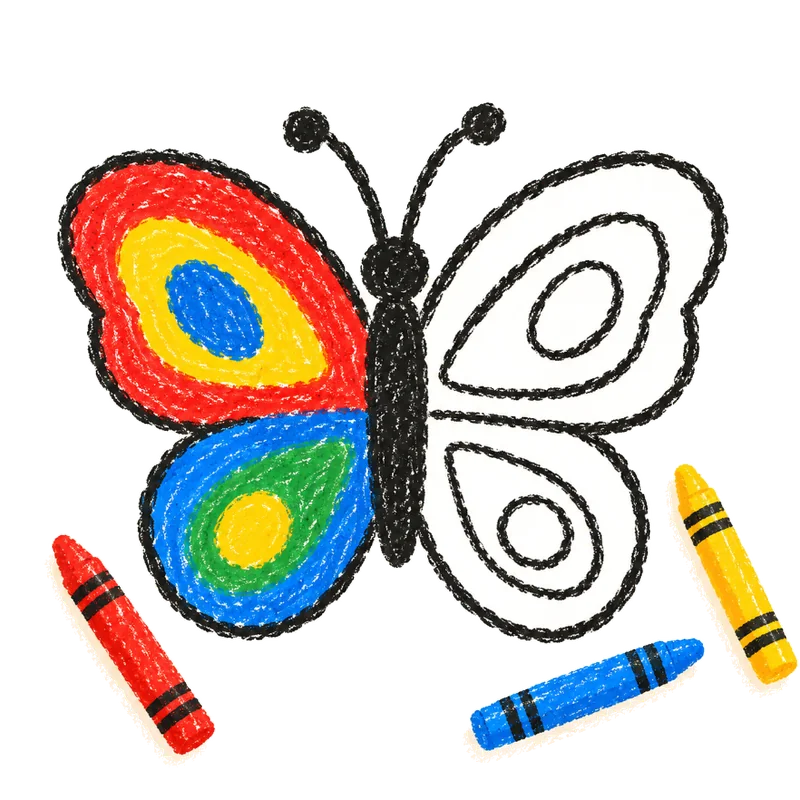
Butterflies are a lovely starting point. Their wings usually have matching shapes on the left and right sides of the body. Give your child a butterfly coloring page and ask them to use the same colors in matching areas on both wings. They do not have to make every tiny detail identical at first. Focus on the larger shapes.
Snowflakes offer another way to explore symmetry. Their arms often repeat around a central point, creating a design that looks balanced from different directions. Ask your child to find matching sections before choosing colors. You can also fold a paper snowflake together and compare its shapes.
Try these questions while your child works: Where is the middle of the picture? Which parts match? What would happen if you colored one wing differently? These questions help children look carefully at shapes instead of coloring on autopilot.
- Can you find the line that divides the butterfly into two matching halves?
- Which snowflake sections have the same shape?
- Can you color both sides using the same color order?
- What changes if one side has a different pattern?
Explore tessellations with honeycombs and triangles
A tessellation is a pattern made from shapes that fit together without gaps or overlaps. The shapes cover a surface like pieces of a puzzle. Children often recognize the idea before they know its mathematical name.
Honeycombs are a familiar example. Bees build their honeycomb from repeated hexagonal cells that fit closely together. Show your child a honeycomb picture and ask them to count the sides of one cell. Then look at how the same shape connects to the cells around it.
Triangles are another useful shape for this activity. Repeated triangles can fit together to cover a flat area. Give your child a page filled with connected triangles and ask them to color neighboring shapes in alternating colors. They can use two colors for a simple pattern or three for a more challenging design.
The important thing is to help your child notice how the shapes meet. Do any spaces remain empty? Are any shapes covering another one? Can the same shape continue across the whole page? These are useful questions for developing spatial awareness.
For children who enjoy this activity, try combining different colors to create larger pictures from small repeated shapes. A simple honeycomb can become a collection of colorful cells, while a triangle grid can look like a patchwork design.
Choose the right math coloring pages for your child's age
Children develop these skills at different speeds, so choose pages based on what your child can comfortably recognize. A five-year-old may enjoy finding two alternating colors, while an eight- or nine-year-old might be ready to invent a pattern with several steps.
For ages 5 and 6, keep the designs open and easy to follow. Use large shapes, clear outlines and short repeating sequences. Ask your child to identify what comes next before they color it. If they get stuck, complete the first two repetitions together.
For ages 7 and 8, introduce longer sequences and simple symmetry challenges. Ask children to finish an ABC pattern or find matching sections in a more detailed butterfly. You can also give them a partially colored design and ask them to work out the rule.
For ages 8 and 9, try tessellations and patterns that change in more than one way. A design might repeat both shape and color, or use a sequence that becomes more complex across the page. Ask your child to explain the rule in their own words.
If your child enjoys familiar pictures, Cute coloring pages can make a comfortable starting point before moving to more structured designs. You can also browse Coloring pages for kids for additional pictures to use in your own pattern challenges. Let your child pick the subject. Interest often makes the activity easier to stick with.
Ask math questions while your child colors
You do not need to turn coloring time into a formal lesson. A few well-timed questions are enough to get children thinking. Let them color for a minute or two before asking anything. That gives them time to notice the shapes and decide what they want to do.
Try asking what comes next in a sequence, how many times a shape repeats or which parts of a picture match. If your child gives an unexpected answer, ask them to explain their thinking. Sometimes they have spotted a different pattern from the one you intended.
You can also make the activity into a small guessing game. Cover the last few shapes in a row with a piece of paper. Ask your child to predict what belongs underneath. Then lift the paper and see if their answer follows the pattern.
For symmetry, ask your child to imagine folding the page down the middle. Would the two sides match? For tessellations, ask whether another shape could fit into an empty space. These small questions encourage children to look at relationships between shapes.
Try a short activity of 10 to 15 minutes rather than expecting your child to finish a complicated page in one sitting. Some children will want to keep going, while others will be ready to move on after a few minutes. Let them stop while the activity is still enjoyable.
You can also ask your child to make a pattern of their own on a blank sheet of paper. They might draw alternating circles and stars, create matching butterfly wings or fill a grid with triangles. Ask them to explain the rule when they finish. If they can teach it to you, they have probably understood the idea.
Questions parents ask
What are easy pattern activities for 5-year-olds?
Start with AB patterns using two colors or two simple shapes. Let your child color a red circle, a blue circle and repeat the sequence. Ask them what should come next.
How do you teach symmetry to children?
Use pictures with two matching sides, such as butterflies. Show your child the middle line and ask them to color matching sections on each side. Folding a paper picture can help explain the idea.
What is a tessellation for kids?
A tessellation is a design made from shapes that fit together without leaving gaps or overlapping. Honeycombs and repeating triangle patterns are good examples for children to color and explore.
More from the blog
All articles 40 brain teasers for kids with answers to try togetherTry 40 brain teasers for kids with answers, including number challenges, word puzzles, patterns and lateral-thinking riddles for home or school.
 75 fun facts for kids that are surprising and trueExplore 75 fun facts for kids about animals, space, the human body, food, oceans, weather and history, plus ideas for family trivia night.
 Quiet time activities for kids who have stopped nappingTry a simple 45-minute quiet time routine for kids ages 3 to 5 who no longer nap, with printable activities, a visible timer and easy rules.