Coloring7 min read
Space activities for kids to try at home and outside
Try five space activities for kids, including rocket coloring, a star dot to dot, space trivia and a backyard night sky hunt.
 By the 123arc teamPublished Oct 31, 2026
Contents
Space activities for kids can start with a box of crayons and end with a look at the real night sky. Try rocket coloring pages, a space word search, a star dot to dot, a few astronomy questions and a backyard scavenger hunt to help your child learn about space through play.
These activities work well for preschoolers, elementary school children and families planning a space-themed afternoon. You can do the printable activities at the kitchen table, then head outside after sunset to look for the moon, stars and moving lights in the sky. You do not need a telescope or a big science lesson to get started.
Start with rocket coloring pages
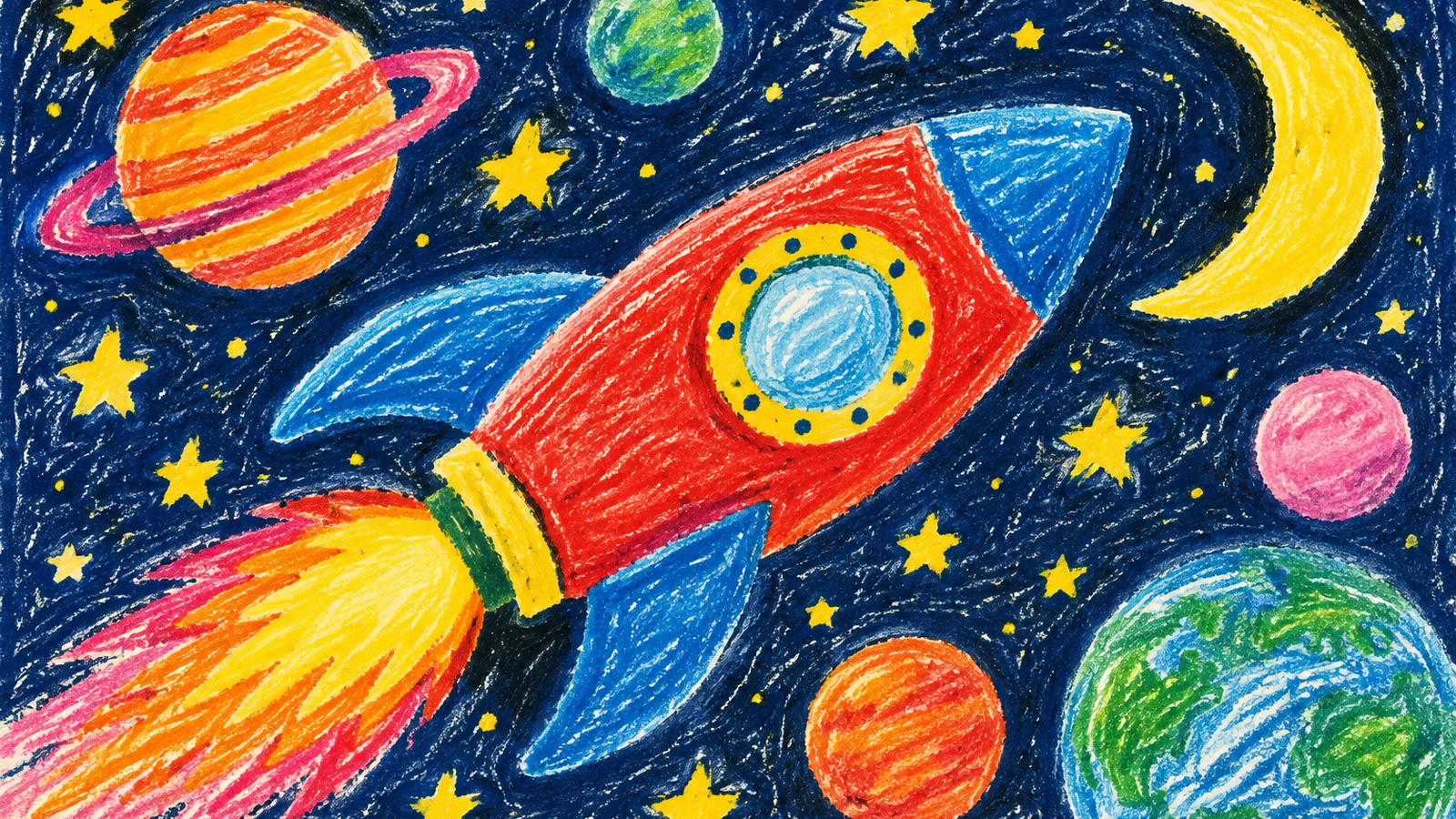
A rocket is a good starting point because children can recognize its shape and imagine where it might go. Print a few rocket coloring pages and put out crayons, colored pencils or washable markers. Ask your child to choose the rocket's colors before starting. Perhaps it has a red nose, blue windows and yellow flames. Another child might prefer a silver rocket with green stripes. There is no need to follow a real rocket's appearance.
For younger children, choose large pictures with thick outlines and plenty of open space. A three or four-year-old may enjoy filling in one rocket without worrying about staying inside every line. Older children can add a launch pad, planets, stars or astronauts around the picture. If your child finishes quickly, ask them to draw what the rocket might see through its windows.
Add a space word search
Once the coloring is finished, introduce a space word search. This gives children a chance to recognize familiar words while staying with the same theme. Start with a small puzzle containing words such as moon, star, sun, Mars, Earth, rocket and space. Read the words together before your child begins looking for them.
The easiest approach depends on your child's reading level. A preschooler can search for individual letters with your help, while a child in kindergarten or first grade may recognize short words independently. Older children can try finding words that run backward or diagonally if the puzzle includes those directions. You can also make your own puzzle with the Word search printable resources. Keep the first round short, especially if your child is still learning to read. Finding three or four words can be enough for one sitting.
Follow the stars with a dot to dot
A star dot to dot is a nice change after a word puzzle. Children follow numbered dots in order, then discover the picture formed by the connecting lines. Look for a simple star outline with a manageable number of dots. Younger children can practice holding a pencil and following the numbers with an adult nearby. Older children may enjoy a more detailed space picture.
Try the Dot to dot printables collection if your child enjoys connecting pictures. Before they start, ask what they think the finished shape will be. A star is an easy prediction, but you can also let them guess whether the picture might become a rocket or another space object. Once the outline is complete, let your child color it and add a dark blue or purple background.
You can turn the finished page into a small conversation about stars. Explain that stars are enormous balls of hot gas that give off light. Our Sun is a star, too. It looks much bigger and brighter than the other stars because it is much closer to Earth.
Play a short space trivia game
Children often have questions about space that come up during ordinary activities. Is the Moon a star? Can people stand on the Sun? Why does the sky look dark at night? A short trivia game gives you a chance to answer some of those questions without asking your child to sit through a long explanation.
Start with a few questions and let your child guess before revealing the answer. Keep the conversation relaxed. If they give an unusual answer, ask how they reached it. Sometimes the explanation behind a guess is more interesting than getting the answer right.
Try these questions together:
What is the closest star to Earth? The Sun.
Does the Moon make its own light? No. We see sunlight reflected from its surface.
What planet do we live on? Earth.
What is the name of the planet known for its large rings? Saturn.
Are stars visible during the day? They are still in the sky, but sunlight makes them difficult to see.
Can you see the Moon during the daytime? Yes. The Moon is sometimes visible during daylight hours, depending on its position.
For more questions, use Trivia questions for kids with answers. Choose a few that suit your child's age rather than working through an entire collection. You can also take turns asking questions. Let your child invent one for you, then swap roles.
Take a night sky scavenger hunt outside
The backyard activity is the part I would save for after dinner. Choose a clear evening, find a comfortable place to stand or sit, and give your child a simple list of things to spot. You do not need special equipment. Your eyes and a little patience are enough to begin.
Use this five-item night sky hunt. Your child can tick each discovery on a piece of paper or simply call it out when they find it.
Look for these things:
The Moon, in any shape or phase.
Three stars, either close together or spread across the sky.
A plane, which may appear as a moving light with blinking lights.
A satellite, which can look like a steady point of light moving across the sky.
Give everyone time to look. Stars can be difficult to see if you are near bright streetlights or windows. Move to a darker part of the yard if it is safe to do so. A satellite may be easier to spot after sunset or before sunrise, when it can reflect sunlight while the ground below is dark.
There is one important distinction to explain during the hunt. A plane usually has blinking lights and may make a sound. A satellite often looks like a steady light moving across the sky without blinking. If your child sees something they cannot identify, that is fine. You can check a sky map or satellite tracking resource together later rather than guessing.
For a longer outdoor activity, try the Outdoor scavenger hunt printable. You can adapt the prompts to include things your child notices in the evening, such as a crescent Moon, a bright planet or a constellation. Never look directly at the Sun to find stars or planets, and keep children supervised outdoors after dark.
Help children check real sky facts
After the activities, spend a few minutes checking something you saw or discussed. NASA's Space Place has child-friendly explanations about the Moon, stars, planets and the solar system. Its pages are useful when your child asks a question that needs a little more than a quick answer. You can read together and compare the information with the guesses made during trivia.
The Moon is a particularly good subject because children can watch it change its appearance over several evenings. Its different phases happen because we see different portions of its sunlit half as it travels around Earth. The Moon does not produce its own light. That small fact can lead to a surprisingly good conversation after a child has colored a picture of it.
You can also check what stars are visible in your area with a reliable sky map. Look up the date and location, then compare the chart with what you can see outside. Some evenings will be cloudy, and some neighborhoods have too much artificial light for faint stars. That is normal. Try again another night rather than turning the activity into a test.
If your child wants to continue the space theme the next day, put the coloring page and scavenger hunt sheet somewhere they can find them. Ask which object they would like to learn about next. A question about Saturn's rings or the Moon's shape can be the starting point for another afternoon of drawing and reading.
Questions parents ask
What are some easy space activities for preschoolers?
Start with large rocket coloring pages, a simple star dot to dot and picture-based space trivia. Keep each activity short and let your child talk about what they are drawing or discovering.
How do I teach my child about space at home?
Use simple printables, ask questions about the Moon and stars, and look at the night sky together. NASA's Space Place is a useful source for checking facts in language children can understand.
What can kids look for in the night sky?
Start with the Moon and three visible stars, then look for a plane or a moving satellite. Choose a clear evening away from bright lights, and supervise children outside after dark.
More from the blog
All articles Dinosaur activities for kids: a five-day printable dino weekPlan five days of dinosaur fun with coloring pages, dot to dots, word searches, trivia and a backyard fossil hunt for kids ages 3 to 8.
 Pattern activities for kids that make math funTry pattern activities for kids that teach repeating sequences, symmetry and tessellations through coloring, drawing and simple questions.
 40 brain teasers for kids with answers to try togetherTry 40 brain teasers for kids with answers, including number challenges, word puzzles, patterns and lateral-thinking riddles for home or school.