Paper8 min read
Story paper: 30 picture writing prompts for young writers
Help your child turn drawings into stories with printable story paper, 30 picture prompts, and a simple month-long plan for building writing skills.
 By the 123arc teamPublished Oct 27, 2026

Contents
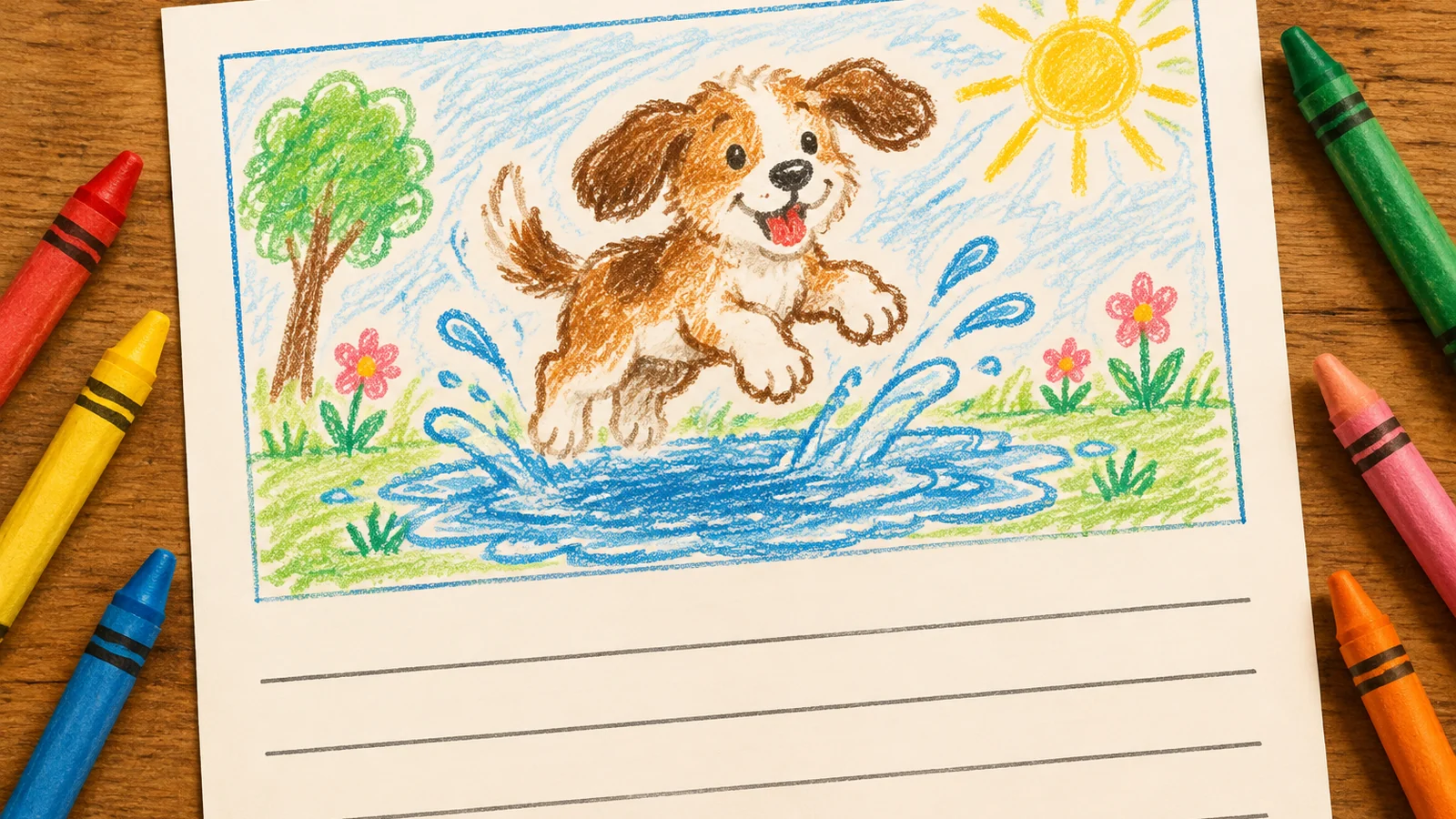
Story paper helps children ages 5 to 7 start writing by giving them a space to draw a picture above a few lines for words. Pair it with one small picture prompt each day, and your child can move from labeling a drawing to writing a sentence and eventually a short paragraph.
If your kindergartner or first grader has plenty to say but freezes when asked to write, this approach gives them somewhere to begin. You do not need fancy supplies or a complicated lesson plan. A pencil, crayons, printable story paper, and about 10 minutes together are enough to get started.
Why a drawing box makes writing easier
Ask a 6-year-old to write a story about anything, and you might get a blank stare. Ask that same child to draw a dog wearing rain boots, and suddenly there is a dog, a puddle, a storm cloud, and a whole story to tell. The picture gives your child something concrete to describe instead of asking them to invent every detail and find the words at the same time.
A drawing box also gives beginning writers permission to start with what they can do. Your child might draw a house, write the word "home," and stop there. That counts as a beginning. You can ask what is happening in the picture, write down the child's spoken sentence if needed, and invite them to copy one word or add another detail.
Keep the drawing area large enough for your child to show an idea clearly, with three to five writing lines underneath. Younger writers often need room for big letters, while a child who is already writing sentences may prefer more lines. Try story paper printable when you want a page that gives the picture and the words their own spaces.
How to use story paper with a 5 to 7 year old
Start with a prompt your child can picture in their mind. Read it aloud, wait a few seconds, and ask what they would like to draw. Avoid explaining exactly what the picture should look like. If the prompt is "A cat finds a tiny door," one child may draw a cat in a garden, while another imagines a door inside a bookshelf. Both have a story worth telling.
Give your child five minutes to draw and another five minutes to write or dictate a sentence. If they are still working happily, let them continue. If they are getting frustrated, stop while the activity still feels manageable. You can return to the same page later rather than turning a short writing exercise into a struggle.
What if your child says they cannot spell a word? Ask them to say the word slowly and listen for the sounds they know. Help with a difficult word when needed, but resist correcting every letter or rewriting the whole sentence for them. At this age, the goal is to help children connect their ideas with written language while they are still learning how spelling works.
30 picture writing prompts to try
Use these kindergarten writing prompts and writing prompts for first grade whenever your child needs a starting point. Each one can lead to a drawing, a spoken story, or a few written sentences. Let your child choose between two prompts if deciding is harder than drawing.
The prompts are grouped by theme so you can pick one that suits the day. Animal stories work well for children who love pets, while weather prompts give them familiar details to describe. Save the silly ideas for days when your child needs a laugh.
- Animals: Draw a puppy who finds a mysterious box.
- Animals: Draw a cat hiding in a cardboard castle.
- Animals: Draw a bird that builds a nest in an unusual place.
- Animals: Draw a turtle racing a rabbit.
- Animals: Draw a fish who wants to visit the moon.
- Animals: Draw a bear making breakfast.
- Animals: Draw a rabbit meeting a friendly frog.
- Animals: Draw a dinosaur looking for its family.
- Weather: Draw yourself jumping in the biggest puddle.
- Weather: Draw a snowman who comes alive at night.
- Weather: Draw a windy day that carries your hat away.
- Weather: Draw a rainbow leading to a secret garden.
- Weather: Draw a cloud that follows you everywhere.
- Weather: Draw a sunny day at your favorite park.
- Weather: Draw a thunderstorm from the viewpoint of a cozy bedroom.
- Weather: Draw a leaf flying on an autumn breeze.
- Family: Draw a meal your family would love to share.
- Family: Draw yourself helping someone at home.
- Family: Draw a pretend adventure with a grandparent.
- Family: Draw a family trip to a place you have never visited.
- Family: Draw something special you do with someone you love.
- Family: Draw a new room you would design for your family.
- Silly: Draw a giraffe trying to fit into a tiny car.
- Silly: Draw a sandwich that can talk.
- Silly: Draw a robot learning to dance.
- Silly: Draw a frog wearing a crown.
- Silly: Draw a giant cupcake in your backyard.
- Silly: Draw a school where the children teach the teachers.
- Silly: Draw a pair of shoes that can run by themselves.
- Silly: Draw what would happen if your toys came alive for one hour.
Help your child turn a picture into a sentence
Once the drawing is finished, talk about it before asking your child to write. Point to one part of the picture and ask, "What is happening here?" If your child says, "Dog rain," you might respond, "The dog is jumping in the rain." Say the complete sentence naturally, then let your child decide which words they want to write.
A simple sentence frame can help children who struggle to get started. Try "I see...", "The ___ is...", or "First..., then..." These frames give your child a way into the task without choosing the whole sentence for them. As their confidence grows, use the frame less often.
Some children can write a full sentence but need help remembering spaces and punctuation. Others are still working on letter formation. Match the support to the child in front of you. If your child is exhausted after writing one sentence, celebrate the idea and leave the next sentence for another day. You can offer primary handwriting paper printable for separate letter practice when handwriting itself is getting in the way of storytelling.
A month-long plan for growing from one sentence to a paragraph
Use four weeks to build the habit gradually. You do not have to complete a page every day. Aim for three or four short sessions each week, and repeat a prompt if your child has more to say. The steps below are a guide, not a test your child must pass on a schedule.
In the first week, focus on drawing and one sentence. You can write the child's spoken words beneath the picture if independent writing is still difficult. During the second week, invite your child to add a detail, such as where the character is or what it is doing. Two sentences are plenty.
In the third week, help your child connect ideas with words such as "and," "then," or "because." For example, "The dog found a key. Then it opened the gate." In the fourth week, aim for three to five related sentences about the same picture. Read them aloud together and ask whether anything is missing from the story.
At the end of the month, look back at the first page beside the most recent one. Your child may have made progress in spelling, sentence length, or the amount of detail in each picture. You might see only one of those changes, and that is fine. Keep the work that feels successful and use it as a starting point for next month.
- Week 1: Draw and write or dictate one sentence.
- Week 2: Write one sentence and add a second detail.
- Week 3: Connect two or three related sentences.
- Week 4: Build a short paragraph of three to five sentences.
Make writing time feel calm, not like homework
Choose a regular time when your child is not hungry or worn out. After school may work for one family, while another child writes best after breakfast on a weekend. Keep crayons, pencils, and printed pages in one folder so you can begin without spending half the session looking for supplies.
Try not to turn every drawing into a spelling lesson. Ask about the story first, because children are more likely to keep writing when they feel heard. You can choose one small thing to practice, such as leaving spaces between words, and leave the rest alone for now.
If your child enjoys drawing but avoids writing, offer to take dictation for the first sentence and invite them to write one familiar word. If they already write easily, ask what happens next or how the character feels. The same prompt can support different skill levels, so you do not need a separate activity for every child.
Keep completed pages in a folder or staple a few together at the end of the month. Children often enjoy seeing their own stories collected in one place. When your child asks to make another page, offer a fresh prompt and let them choose the story.
Questions parents ask
What is story paper for kindergarten?
Story paper usually has a large box for drawing and lines below for writing. It helps kindergarten children connect a picture with a word, sentence, or short story.
How long should a first grader write each day?
Start with about 10 minutes and adjust to your child's attention and comfort. A child who writes one thoughtful sentence may get more from the activity than a child pushed to fill a whole page.
How can I help my child who hates writing?
Begin with a topic your child already loves and let them draw before asking for words. Offer to write down their spoken sentence, then invite them to copy one word or add a short phrase of their own.
More from the blog
All articles Graph paper activities for kids: 12 printable grid ideasTry 12 graph paper activities for kids, including pixel art, math games, symmetry drawings and coordinate pictures, with tips for choosing grid sizes.
 Handwriting Paper for Kindergarten and Early GradesChoose handwriting paper for your child's age and writing skills. Learn how dashed midlines, line sizes, and story paper support early writers.
 Morning work kindergarten: a five-minute routine that runs itselfBuild a calm kindergarten arrival routine with five-minute printables, one task each day, and simple habits that help children start work independently.