Games8 min read
Family game night ideas kids will ask to play every week
Plan a family game night kids look forward to every week. Get 20 easy game ideas, printable activities and tips for playing across ages 4 to 12.
 By the 123arc teamPublished Nov 22, 2026
Contents
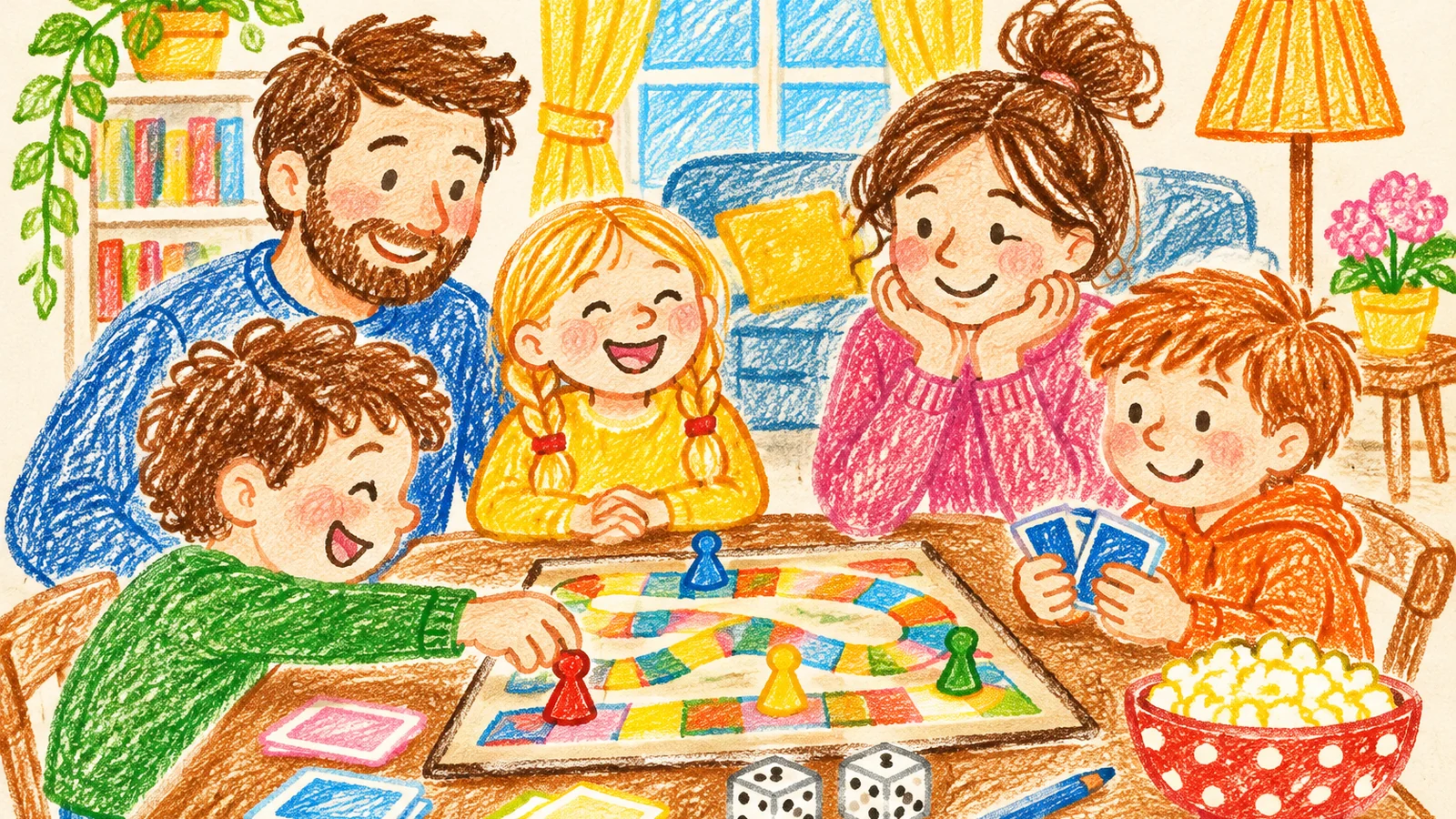
The best family game night ideas are easy to set up, short enough to hold a child's attention and fun for adults too. Pick the same evening each week, let your kids take turns choosing the games and put out one simple snack before everyone sits down.
If you have children between 4 and 12, you already know that getting everyone to agree on one game can be harder than playing it. A preschooler might want to roll dice while an older sibling wants to win a strategy game. These ideas give you options for different ages, different moods and evenings when you would rather not buy anything new.
Set up a family game night that sticks
Choose one evening and keep it as your regular game night. Friday after dinner works for many families, but Sunday afternoon is just as good if bedtime is already a struggle. Aim for 45 to 60 minutes at first. You can always play longer when everyone is having fun.
Give each child a turn choosing the main game. If you have three children, rotate the choice each week rather than letting the oldest make every decision. Younger children can choose between two games you have already approved. That gives them a real say without leaving you with a game nobody else wants to play.
Keep the snack simple. Popcorn, apple slices, pretzels or small bowls of crackers are easy to put on the table. Set drinks away from cards and paper games. Honestly, a little preparation makes the evening much easier. Put the phones aside, clear the table and agree that everyone gets a chance to play.
- Choose the same night every week.
- Let a different child pick the game each time.
- Prepare one easy snack before playing.
- Start with one game and add another if everyone wants to continue.
No-cost family games you can play anywhere
You can have a good family game night without buying a single thing. These seven games need only people, a little space and, occasionally, a pencil and paper. They work especially well when you have children who want to start playing straight away.
Charades is a good first choice for mixed ages. One person acts out an animal, job or familiar activity while everyone else guesses. Let younger children make animal sounds or use simple movements instead of expecting them to act out complicated ideas. Older children can try a harder round without speaking.
A drawing guessing game needs paper and pencils. One player draws something while the others try to guess it before the drawing is finished. Give younger children easy subjects such as a house, cat or sun. Older players can draw without lifting their pencil or without using any words.
Twenty Questions is another easy option. One person thinks of an animal, object or person, and everyone else asks questions that can be answered with yes or no. You get 20 questions to work out the answer. For younger players, stick to familiar things around the house.
Try four more games when the first choices get repetitive. In Categories, choose a topic such as foods and take turns naming something that belongs. In Telephone, whisper a sentence around the group and compare the final version with the original. Freeze Dance needs music and a person to pause it. Everyone freezes when the music stops. For a memory tray game, show a few household objects, cover them with a towel and ask players what they remember.
- Charades
- Drawing guessing game
- Twenty Questions
- Categories
- Telephone
- Freeze Dance
- Memory Tray
Printable games for a fresh game night
Printable games are useful when you want something ready before the family sits down. Print a few pages ahead of time and keep them in a folder with pencils, crayons and spare paper. You can bring the folder out whenever the usual games have lost their appeal.
Trivia cards make a good team game. Read a question aloud and let everyone take turns answering. Choose subjects children already know, such as animals, food, cartoons or everyday science. Pair a younger child with an older sibling if some questions are harder than others. You can find ideas in our [trivia questions for kids with answers](https://123arc.com/trivia-questions-for-kids/).
Would you rather is especially good for getting everyone talking. Ask questions such as whether someone would rather live in a treehouse or underwater, or have a pet dragon or a talking dog. Each player picks an answer and explains why. There is no need for a winner. Try our [Would you rather questions for kids](https://123arc.com/would-you-rather-questions-for-kids/) when you need fresh questions.
A word search race gives readers something to work on together. Print the same puzzle for everyone and see who finds the most words in five minutes. For a younger child, use a simpler puzzle or let an adult help. You can choose a theme everyone enjoys from our [word search printable](https://123arc.com/word-search-printable/).
Dots and boxes is a good quiet game for two or more players taking turns on a sheet of dot grid paper. Draw a line between two neighboring dots. When you complete the fourth side of a square, write your initial inside it and take another turn. The player with the most completed squares wins. Print dot grid paper and make a large grid for younger children.
- Printable trivia cards
- Would you rather questions
- Word search race
- Dots and boxes
Card and board game picks by age
Choose card and board games according to the youngest player's abilities, not just their age. A game with too many rules can lose a four-year-old before the first round ends. For older children, look for games that involve planning, memory or making decisions.
For ages 4 to 6, matching games are a good starting point because children can turn over cards and look for pairs. Go Fish is another option for practicing matching and taking turns. Simple picture bingo works well too. Keep the rounds short and help with the rules when needed.
For ages 7 to 9, try Crazy Eights, simple domino games and checkers. These give children more chances to think ahead while still keeping the rules manageable. A basic family board game with a spinner or dice can also work well if everyone understands what happens on each turn.
For ages 10 to 12, try chess, more involved strategy board games or card games that require players to plan several moves ahead. These children may enjoy keeping score across several rounds. If younger siblings want to join, let them play with a teammate rather than giving them a separate, easier game.
What if your children are several years apart? Choose a game where luck has a part in the result, or play in mixed-age teams. An older child can help a younger one read a card or remember a rule. Avoid making the oldest child responsible for teaching every round. Let the adult explain the game first.
- Matching card game, ages 4 to 6
- Go Fish, ages 4 to 6
- Picture bingo, ages 4 to 6
- Crazy Eights, ages 7 to 9
- Dominoes, ages 7 to 9
- Checkers, ages 7 to 9
- Chess, ages 10 to 12
- Strategy board game, ages 10 to 12
Handle mixed ages and sore losers kindly
Mixed-age game nights work best when you adjust the rules instead of expecting every child to play at the same level. A four-year-old might need picture clues, extra thinking time or help counting spaces. An older child can take on a harder challenge within the same game.
Try making teams with one younger and one older player. This gives siblings a reason to help each other instead of competing over every small mistake. You can also change the scoring so that younger players get a point for completing a simple task while older players earn points for a harder version.
What happens when someone loses and gets upset? Keep your response calm. Acknowledge that losing feels disappointing, then give the child a moment to settle down. Avoid teasing or telling them they are being silly. You can say, "You wanted to win that round. Let's take a breath and see if you want another turn."
Set a few rules before the first game. Nobody changes the rules halfway through, everyone gets a turn and nobody makes fun of another player's mistakes. If a child needs a break, let them sit out one round. You do not have to finish every game that you start.
End the evening while the mood is still good. Let the child who will choose next week announce their pick before everyone puts the games away. Keep the activity folder and board games in one easy-to-reach place. That small routine gives your children something familiar to look forward to next week.
- Mixed-age team challenge, with younger and older players working together
Questions parents ask
How often should you have family game night?
Once a week is a good starting point because children can look forward to a regular evening. Keep the night flexible if your family has a busy schedule, but try to stick to the same day when possible.
What are some family games to play at home without buying anything?
Try charades, Twenty Questions, Categories, Freeze Dance, Telephone or a drawing guessing game. All you need is a group of players, and some games need only paper and pencils.
How do you make family game night fun for different ages?
Choose simple games with optional harder rules, or pair younger and older children into teams. Give everyone a fair turn and avoid making winning the only reason to play.
More from the blog
All articles Activities for 5 year olds at home, with 30 ideasTry 30 activities for 5 year olds at home, including board games, reading practice, puzzles, creative projects, outdoor play and helpful jobs.
 Nature scavenger hunt for kids in every seasonTake your kids outside with nature scavenger hunt lists for every season, plus toddler-friendly color hunts, backyard ideas and simple nature journaling.
 Valentine's Day activities for kids at home and schoolPlan Valentine's Day fun with heart crafts, scavenger hunts, printable games and a 45-minute classroom party for children ages 3 to 10.