Paper6 min read
Graph paper activities for kids: 12 printable grid ideas
Try 12 graph paper activities for kids, including pixel art, math games, symmetry drawings and coordinate pictures, with tips for choosing grid sizes.
 By the 123arc teamPublished Oct 26, 2026
Contents
Graph paper activities for kids turn an ordinary sheet of squares into a place to draw pixel pictures, practice multiplication, build mazes and explore geometry. A free printable graph paper sheet gives your child a simple structure for creative play and schoolwork, with activities you can adjust to suit different ages.
Keep a few printed grids beside your child's crayons, pencils and ruler for rainy afternoons, homework breaks or quiet time at the kitchen table. Preschoolers can trace lines and fill squares, while elementary school children can work with coordinates, area and multiplication. The best activity depends on what your child enjoys and how comfortable they are counting squares.
1. Make pixel art with colored squares
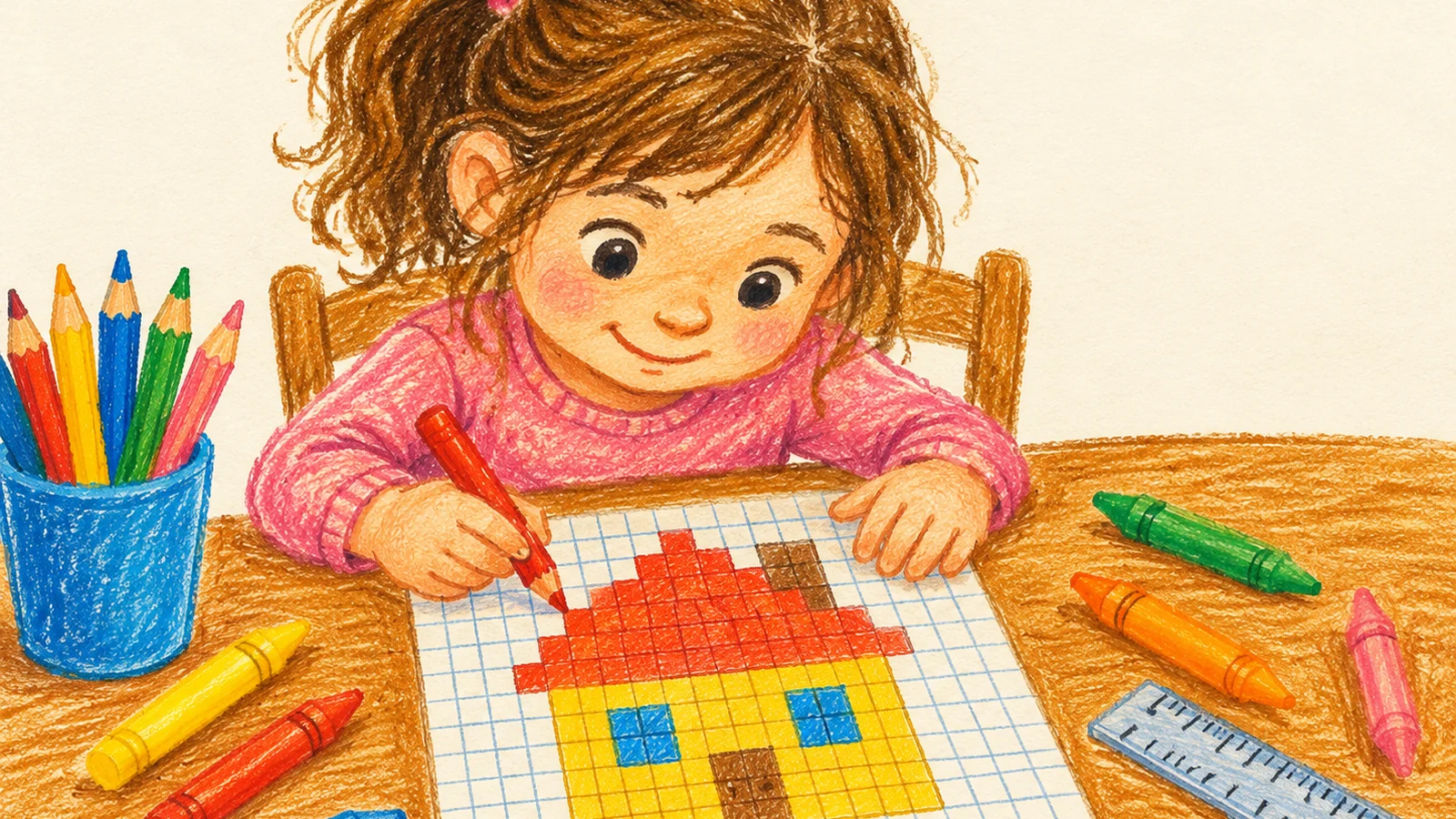
Pixel art is one of the easiest ways to introduce graph paper art. Each square becomes one tiny piece of a picture, much like the blocks in a simple video game. Your child can make a heart, smiley face, mushroom, cat or small house by coloring individual squares with crayons or colored pencils.
Start with a grid that has fairly large squares so your child can color inside the lines without getting frustrated. Draw a simple picture on a separate sheet, then ask your child to copy it square by square. Older children can design their own characters and use a color key to plan each section before filling it in.
- Try a 10 by 10 grid for a small picture.
- Use one color per square and leave white squares uncolored.
- Challenge older children to create a picture using only four colors.
2. Draw symmetrical pictures
A grid makes symmetry easier to see because each square gives your child a reference point. Draw a vertical line down the middle of the page and sketch half a butterfly, robot, flower or funny face on one side. Have your child copy the shapes onto the other side, counting squares to keep matching parts the same distance from the center.
For a younger child, draw the first half yourself and let them finish the matching side. Children who already understand coordinates can make their own half-picture and challenge a friend to complete it. If the first attempt looks uneven, compare the squares together and fix one small section at a time.
- Use a large grid for preschool and kindergarten children.
- Try a butterfly or simple geometric pattern for older children.
- Ask your child to explain which squares match across the center line.
3. Build multiplication arrays
Graph paper gives multiplication a physical shape. Ask your child to shade three rows of four squares, then count the total. They can see that 3 groups of 4 make 12, and that the same rectangle contains 4 rows of 3. This is a useful activity for children who can count but still find multiplication facts hard to picture.
Start with small arrays such as 2 by 3 or 4 by 4. Write the matching multiplication sentence beside each rectangle, then let your child make an array for a fact they are learning at school. You can also compare two rectangles with the same area, such as 2 by 6 and 3 by 4, to show how different arrangements can contain the same number of squares.
4. Explore area and perimeter
Once your child can count squares confidently, use the grid to investigate area and perimeter. Draw a rectangle four squares wide and three squares tall. Your child can count 12 square units inside it to find the area, then count the outside edges to find a perimeter of 14 units.
Keep the first shapes rectangular and use a pencil so mistakes are easy to correct. Later, try an L-shaped figure or a simple floor plan for a bedroom. Ask your child to find two shapes with the same area but different perimeters. This turns a worksheet task into a small puzzle with a clear visual answer.
5. Make bar graphs and coordinate pictures
A grid helps children organize information and understand where things belong. For a bar graph, ask your child to survey the family about favorite fruits or pets. Write the choices along the bottom, then shade one square for each vote. If apples receive five votes, the apple bar should rise five squares. Keep the numbers small enough for your child to count each block.
Coordinate pictures are a good next step for children who know how to read a simple numbered grid. Label the horizontal and vertical edges, then give a sequence of points to plot and connect. The finished lines might form a rocket, sailboat or house. You can also let your child create a set of coordinates for you to follow, which gives them practice explaining directions clearly.
- Use a simple tally before drawing the bar graph.
- Number the axes clearly for coordinate work.
- Begin with a short list of points before trying a larger picture.
6. Invent grid mazes, Battleship and 3D cubes
For a quiet afternoon, ask your child to design a maze on graph paper. They can draw walls along the grid lines, mark a start and finish, and leave a route through the squares. Younger children can trace a path through a maze you have drawn, while older children can make dead ends and test whether a friend can solve the puzzle.
Battleship is another useful grid game for children who can follow row and column labels. Draw matching grids for two players, place ships in squares and take turns calling out coordinates. Keep the rules simple at first, and check that both players label their grids in the same way. It is a fun reason to practice letters, numbers and careful listening.
For a drawing challenge, try dot paper instead of a regular square grid. Mark dots at the corners of small cube shapes and connect them with straight lines to create a block that looks three-dimensional. Children can repeat the cubes to make a staircase, a stack of blocks or a simple city. If the lines feel difficult at first, draw one cube together and let your child add the next.
Which grid size should you print?
The size of each square changes how an activity feels. Large squares give young children more room to color, trace and count. Smaller squares fit more detail on one page, which helps with pixel art, coordinate drawings and math problems that need several rows or columns. Check the scale before printing, because a grid that looks roomy on a screen may be much smaller on paper.
For most activities, choose a grid that lets your child work without squeezing numbers or drawings into tiny spaces. You can print the same design at different scales to see which version feels right. Dot paper works well for 3D cube drawings because the dots mark the corners without adding full lines across the page.
Need a change of pace after grid work? Try Dot to dot printables for number-order practice, or use Coloring pages for kids when your child wants a picture without planning every square. For younger children who are still building pencil control, Easy coloring pages for toddlers and preschoolers offer a less demanding activity.
Questions parents ask
What can kids do with graph paper?
Kids can make pixel art, draw symmetrical pictures, build multiplication arrays, measure area and perimeter, create bar graphs and design mazes. Older children can also plot coordinates and play grid-based games.
What size graph paper is best for kids?
Larger squares are usually easier for preschoolers and children who are learning to control a pencil. Smaller squares work well for detailed pictures, coordinate activities and math tasks that need more space.
Can preschoolers use graph paper?
Yes. Offer a grid with large squares and invite your child to trace lines, color individual boxes or copy a simple pattern. Keep the activity short and let them stop when their hands get tired.
More from the blog
All articles Handwriting Paper for Kindergarten and Early GradesChoose handwriting paper for your child's age and writing skills. Learn how dashed midlines, line sizes, and story paper support early writers.
 Morning work kindergarten: a five-minute routine that runs itselfBuild a calm kindergarten arrival routine with five-minute printables, one task each day, and simple habits that help children start work independently.
 Skip counting activities by 2s, 5s and 10s for kidsTry skip counting activities with chants, hopscotch, dot to dots and coins. Help your child count with confidence and prepare for multiplication.