Paper9 min read
Handwriting Paper for Kindergarten and Early Grades
Choose handwriting paper for your child's age and writing skills. Learn how dashed midlines, line sizes, and story paper support early writers.
 By the 123arc teamPublished Oct 26, 2026
Contents
- Why the dashed middle line matters
- Which primary writing paper size should you choose?
- Match the paper to your child's stage
- When to move to wide-ruled and college-ruled paper
- Use story paper for children who are just starting to write
- Signs the handwriting lines are too small
- Print at 100 percent for the right line spacing
- Questions parents ask
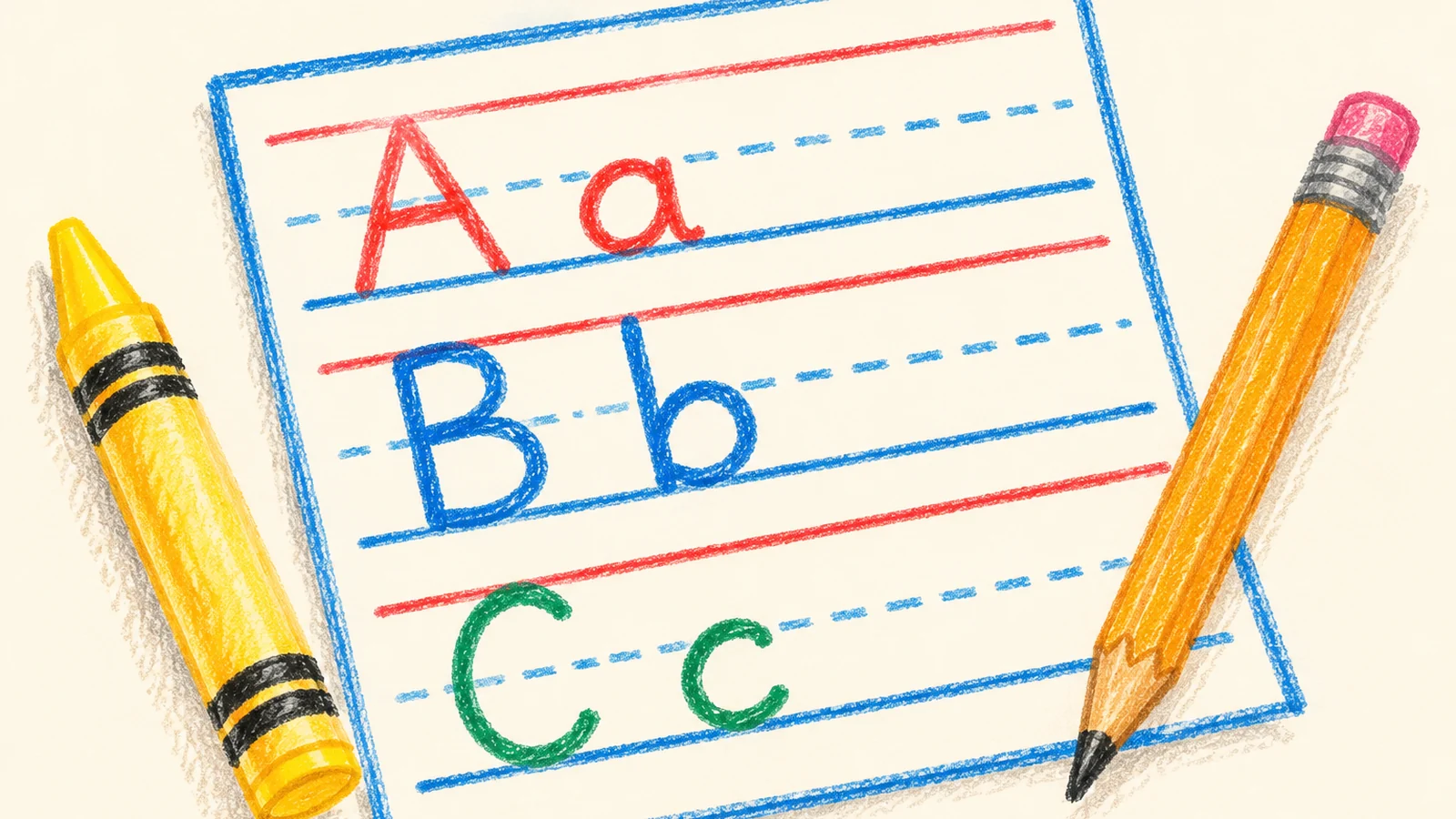
The best handwriting paper for your child has lines that match the size of their letters and the control they have with a pencil. Most children starting pre-K or kindergarten benefit from primary writing paper with a solid bottom line, a dashed middle line, and a solid top line.
If you are a parent helping with homework, a teacher preparing writing centers, or a caregiver looking for extra pencil practice, the right printable can make writing feel less frustrating. Start with the child's current skills, not just their grade. A child who still struggles to keep letters between the lines needs more room, even if classmates have moved on.
Why the dashed middle line matters
Primary handwriting paper usually has three horizontal guides. The bottom line shows where letters sit, the top line marks their usual height, and the dashed line in the middle helps children judge how tall each letter should be. Together, these guides give young writers a clear place to start and stop each stroke.
Think about a lowercase a, c, or e. These letters usually fit between the middle and bottom lines. A tall letter such as b or h reaches toward the top line, while a letter with a tail, such as g or y, drops below the bottom line when the paper includes a descender guide or extra writing space. The dashed line helps children see these differences instead of making every letter the same height.
What if your child ignores the dashed line? That is common while they are learning. Point to the middle line, write one example together, and ask your child to copy it. Keep the practice short and calm. You want the lines to guide the pencil, not become another reason to worry about getting a letter wrong.
Which primary writing paper size should you choose?
Primary writing paper comes in different line heights because young children need more room to form letters than experienced writers. Printable generators may offer small, medium, and large versions, though the exact measurements can vary by page. Check the spacing shown on the printable rather than assuming every version uses the same dimensions.
Large primary lines are a good starting point for many pre-K children and early writers who are still learning to control a pencil. The generous space makes it easier to see where letters begin, how tall they should be, and where a tail belongs. Children who make oversized letters may benefit from this size while they build control.
Medium lines often suit kindergarteners who can form familiar letters but need regular reminders about size and placement. Smaller primary lines can work well for children in first or second grade who already keep most letters within the guides. These are starting points, not strict age rules. A child can move between sizes as needed.
Try a single page before printing a whole packet. Ask your child to write their name and a short sentence, then look at the results together. If letters regularly touch the wrong lines or crowd each other, use more space. If the child writes comfortably and leaves plenty of room, try the next smaller size.
- Large lines: useful for early pencil practice and oversized letter formation.
- Medium lines: useful when children are learning to keep letters a consistent height.
- Small lines: useful when letter size and spacing are becoming more consistent.
Match the paper to your child's stage
In pre-K, the goal is often to get comfortable holding a crayon or pencil, making marks, tracing simple shapes, and recognizing the direction of a letter. Some children are ready to write their names, while others still need time with drawing and tracing. Large primary lines can introduce the idea of a writing space without asking for neat sentences too soon.
Kindergarten is often when children begin practicing uppercase and lowercase letters, their names, and short words. Primary paper with a dashed midline gives them a visual guide for letter height. If your child is learning a new letter, model it once and let them try a few times rather than filling a page with repetitions.
In first grade, many children start writing complete sentences and short responses. Medium or small primary lines may fit their growing control, but keep wider spacing if letters drift above or below the guides. Second graders who form letters comfortably may be ready to try regular wide-ruled paper for longer work.
The grade on a school report does not tell you everything. A child who has been absent, is learning English, or simply needs more time may benefit from a larger writing space for longer than a classmate. Choose the paper that helps your child write with control today.
When to move to wide-ruled and college-ruled paper
Wide-ruled paper has more vertical space between its horizontal lines than college-ruled paper. It is often a practical next step once a child can form letters without relying on a dashed midline for every word. Many children make this change during the elementary years, but readiness matters more than a fixed birthday or grade.
Try wide-ruled paper when your child can write a short sentence on primary paper and keep most letters aligned without constant reminders. The simpler lines leave room for handwriting to grow while still giving the child a clear baseline. If the transition causes letters to float or shrink unevenly, return to primary paper for a little longer.
College-ruled paper has narrower spacing and is usually better suited to writers who can keep letters small and consistent. It leaves more room for notes on a page, but it can be discouraging for a child whose letters still need extra height. There is no benefit to moving early if the writing becomes hard to read.
How can you tell the new paper is working? Your child can finish a short task without squeezing letters together or asking where each letter belongs. Keep a few sheets of the previous size nearby so you can switch back for handwriting practice if needed.
Use story paper for children who are just starting to write
Story paper printable pages combine space for a picture with lines for words or sentences. They work well for children who have an idea to share but are not yet ready to fill a whole page with writing. A child can draw a dog, a trip to the park, or an imaginary creature, then add a name, a label, or one sentence underneath.
For a beginning writer, the picture gives the writing a purpose. Instead of copying random words, the child can tell you what is happening in the drawing and choose a sentence to write. You can help spell a word when needed without taking over the whole task.
Choose story paper with primary lines if your child is still learning letter height. A page with a large drawing area and just a few writing lines may feel more manageable than a full sheet of handwriting practice. As writing becomes easier, offer more lines or ask for an extra sentence.
You can also pair story writing with a short warm-up. Let your child draw for five minutes, talk about the picture, then write one sentence. If they are tired, accept a dictated sentence that you write down for them and invite them to add a word or label of their own.
Signs the handwriting lines are too small
The clearest sign is repeated difficulty, not one messy page. If your child's letters often cross the top and bottom lines, touch the dashed midline in unexpected places, or become cramped inside each writing space, the lines may be too small for their current control. The same is true if the child has to concentrate so hard on letter size that they cannot think about what they want to say.
Watch what happens during a short task. Does your child start neatly and then squeeze letters together near the end? Do tall letters look no taller than short ones? Do lowercase letters repeatedly drift above the middle line? Try a larger version and compare the results on similar tasks.
Handwriting also depends on comfort and practice, so small lines are not always the only issue. A child may be tired, rushing, using an awkward pencil grip, or still learning how a letter is formed. Offer a thicker pencil or crayon if it helps, and give them a break before trying again.
If writing remains unusually difficult or causes ongoing distress despite suitable paper and calm practice, talk with the child's teacher. They can compare classroom work and suggest the next step. For now, give your child enough space to write without fighting the page.
Print at 100 percent for the right line spacing
A printable can have the right layout on screen and still come out with the wrong spacing if the printer scales it. Before printing a stack, open the print settings and choose 100 percent or Actual size. Avoid options such as Fit to page if they shrink the writing area to match the printer margins.
Print one test sheet and measure the space between the lines if you are unsure. Check that the dashed midline is visible and that the page has not been clipped along the edges. If the printer cannot fit the full page at actual size, use a supported paper size or adjust the page layout rather than accepting a smaller writing area.
Keep a few versions ready for different activities. Use primary writing paper for letter formation, story paper for drawing and sentences, and regular wide-ruled paper when your child is ready to write without the middle guide. You can find more options in Primary handwriting paper printable and Lined paper printable.
For younger children who need a gentler start, pair writing practice with Easy coloring pages for toddlers and preschoolers. Coloring and drawing give children a chance to practice controlling a crayon before they work on letter shapes. Keep the activity brief, offer help when they ask, and stop before frustration takes over.
Questions parents ask
What handwriting paper should kindergarteners use?
Primary writing paper with a solid top line, a dashed middle line, and a solid bottom line is a useful starting point. Choose large or medium spacing based on how comfortably your child forms letters.
When should my child stop using primary paper?
Consider wide-ruled paper when your child can form most letters at a consistent height without needing the dashed midline. If letter size becomes uneven or writing gets harder to read, keep using primary paper a little longer.
Why does handwriting paper have a dashed line?
The dashed line guides the height of many lowercase letters and helps children distinguish short letters from tall ones. It gives beginning writers a visual reference as they learn to place letters between the top and bottom lines.
More from the blog
All articles Morning work kindergarten: a five-minute routine that runs itselfBuild a calm kindergarten arrival routine with five-minute printables, one task each day, and simple habits that help children start work independently.
 Skip counting activities by 2s, 5s and 10s for kidsTry skip counting activities with chants, hopscotch, dot to dots and coins. Help your child count with confidence and prepare for multiplication.
 Early finisher activities that do not need gradingBuild a ready-to-use binder of early finisher activities with printable mazes, word searches, color by number and dot to dots kids can check themselves.