Coloring7 min read
Mandala coloring pages for kids: a calm 20-minute break
Use mandala coloring pages for kids to create a calm 20-minute break after school, with simple color rules and tips for choosing designs.
 By the 123arc teamPublished Oct 19, 2026
Contents
- Why repeated shapes can feel calming
- Set up a calm 20-minute coloring break
- Use the three-color rule to make choices easier
- Start in the middle and work outward
- Choose between simple six-fold designs and detailed mandalas
- Pick pencils or markers for the result you want
- Use mandalas as an after-school cool-down
- Questions parents ask
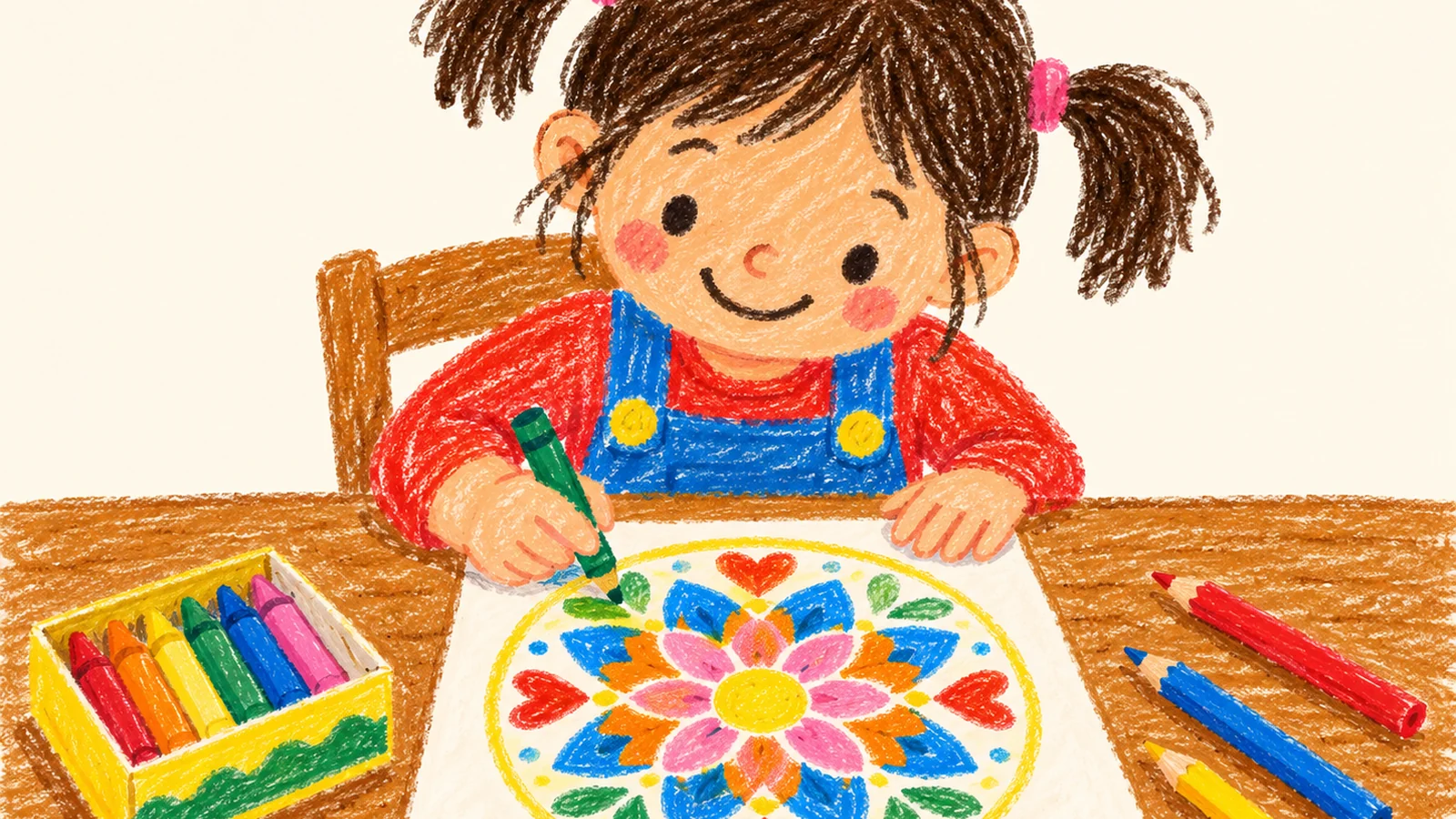
Mandala coloring pages for kids can turn 20 minutes with crayons or colored pencils into a quiet break after a busy school day. Repeated shapes give children something familiar to focus on, and a simple three-color rule helps them begin without worrying about every choice.
This activity works best for children ages 6 and up who enjoy drawing patterns or need a little space after school. You do not need special art supplies or a perfect finished picture. Pick a design that fits your child's patience that day, sit nearby if they want company, and let the coloring take its own course.
Why repeated shapes can feel calming
Look at a mandala and you will usually see shapes arranged around a center. A circle of petals repeats, then another ring adds small leaves, dots, or curved lines. Once a child understands the pattern, there is less need to decide what to draw next. They can focus on filling one small space at a time.
That repetition can make mandala coloring a useful quiet activity. Your child still has choices, but the page gives those choices a clear boundary. After a noisy school day, that structure may feel easier than a blank sheet of paper or a craft project with several steps.
Be careful not to turn coloring into a test of how calm a child can become. Some children settle quickly, while others chat, shift in their seats, or color with great enthusiasm. The goal is to offer a pleasant pause, not to demand silence or promise that coloring will fix a difficult mood.
Set up a calm 20-minute coloring break
You do not need a timer unless your child likes having one. If the page takes longer, save it for tomorrow. If your child finishes in 12 minutes, that is fine too. The routine is there to make starting easier, not to create another deadline.
For a younger child who is just turning six, sit together for the first few minutes and help with the first color choice. Older children may prefer to work alone with music playing softly or while you read nearby.
- Minutes 1 to 3: Choose a mandala and pick three colors.
- Minutes 4 to 8: Color the center and the first ring of shapes.
- Minutes 9 to 15: Continue into the outer rings, repeating colors if desired.
- Minutes 16 to 20: Finish a few favorite spaces, add small details, or stop when the page feels complete.
Use the three-color rule to make choices easier
Three colors are enough for a first mandala. Invite your child to choose one main color, one color that looks different beside it, and one extra shade for small details. Blue, yellow, and green work well together, but there is no need to follow a color theory lesson. Let your child make the choices.
Why limit the palette? A page with dozens of tiny sections can make every new shape feel like another decision. Three pencils keep the choices manageable, and repeating the same color in different rings helps the design feel connected.
If your child wants a fourth color halfway through, let them add one. The rule is a starting point, not a restriction. Some children love careful color planning, while others prefer to grab a new crayon whenever an idea strikes. Both approaches belong in a relaxed art session.
You can also offer a small challenge for children who enjoy patterns. Ask them to alternate two colors around one ring, then use the third color for the next ring. If they lose the pattern or change their minds, there is no need to start over.
Start in the middle and work outward
The center is a natural place to begin because it gives the rest of the picture a starting point. Ask your child to color the smallest shape first, then move into the next ring. They can repeat a color, alternate two shades, or give each ring its own combination.
Working from the middle out can also make the page feel less overwhelming. Instead of staring at dozens of empty spaces, your child has one clear next step. The colored center becomes a visual anchor as the pattern grows.
There is no rule that says every matching shape must have the same color. Children who enjoy symmetry may want to mirror colors on opposite sides. Others may create a different combination in each section. Let the page reflect the way they like to work.
If your child starts at the edge, that is fine. Some designs are easier to approach from the outside, especially when the center has very small shapes. Offer the middle-out method as an idea rather than correcting their technique.
Choose between simple six-fold designs and detailed mandalas
For a first mandala, look for a design with six repeated sections or another clear pattern and fairly large spaces. Six-fold symmetry means a shape or section repeats six times around the center. Children can see the repetition without having to manage dozens of tiny details.
A simple design is a good fit when your child is new to mandalas, tired after school, or easily frustrated by coloring inside narrow lines. Large petals, broad bands, and open circles leave room for crayons and less precise hand movements.
More detailed mandalas suit children who enjoy taking their time. Look for several rings of small petals, dots, and fine shapes when your child wants a longer project. These pages can be satisfying for a child who likes careful work, but they may feel like homework to someone who just wants to relax.
Start with a page that looks inviting rather than impressive. You can browse Mandala coloring pages for repeating patterns, or try Pattern coloring pages if your child prefers geometric shapes and simpler designs. Keep a few easier pages ready for days when attention runs short.
Pick pencils or markers for the result you want
Colored pencils are my first choice for detailed mandalas. Their narrow tips reach small spaces, and children can use light pressure for pale colors or press harder for stronger shades. Pencils also let them blend two colors gently where neighboring sections meet.
Crayons work well on pages with larger shapes. They are comfortable for younger children to grip, and broad strokes fill open spaces quickly. Choose a sharpened crayon tip for small details, or keep the design simple enough that precision is not a concern.
Markers give bold, bright color with little effort. They are useful for children who dislike the texture of pencils or want each shape to stand out. Test them on the paper first, especially if the page is printed on thin paper, because some markers bleed through to the other side.
Keep the materials matched to the page. Fine lines call for pencils or fine-tip markers, while wide petals are easy to color with crayons. If your child is worried about making mistakes, remind them that a slightly uneven edge will not spoil the design.
Use mandalas as an after-school cool-down
The easiest time to try mandala coloring is when your child has had a chance to eat, drink, and take a short break after school. Some children want to tell you everything that happened before they sit down. Others need a little quiet before they are ready to talk. Let your child choose the order.
Keep the invitation simple: "Want to color a mandala for a few minutes?" Avoid presenting the activity as a consequence for being loud or upset. Coloring should feel like an option they can look forward to, not a task they have to complete before doing something fun.
You can sit beside your child and color your own page, or leave them to work independently. If conversation comes naturally, talk. If they prefer quiet, respect that too. There is no need to ask about every color choice or praise each section as it is finished.
What if your child gets restless halfway through? Let them stand, stretch, or put the page aside. A short session that ends on a good note is better than insisting they complete all the rings. Save the unfinished page where they can return to it later.
For a gentle start, print two designs: one with broad, repeated shapes and another with finer details. Let your child choose based on how they feel that afternoon. After a few sessions, you may find that they reach for mandalas on their own when they want something quiet to do.
Questions parents ask
Are mandala coloring pages good for kids?
They offer a structured art activity with repeated shapes and plenty of room for personal choices. Many children enjoy the steady rhythm of coloring, though the experience depends on the child's interests and mood.
What age can kids start coloring mandalas?
Simple mandalas are a good starting point for children around age 6 and up. Choose larger spaces and fewer details for beginners, then try finer patterns if your child enjoys careful coloring.
How long should a child color a mandala?
Try a 10 to 20-minute session and let your child stop when they have had enough. A mandala does not need to be finished in one sitting to be enjoyable.
More from the blog
All articles Name coloring pages: 8 fun ways to use themTry eight easy ways to use name coloring pages at home or school, from birthday place cards and cubby labels to tracing practice and reusable activities.
 Benefits of coloring for kids, by age and skillLearn the benefits of coloring for kids at each age, with practical page ideas for grip, pencil control, color choices, patterns and shading.
 Number recognition activities for preschoolers with no prepTry easy number recognition activities for preschoolers ages 3 to 5, with coloring, counting, dot to dots and number hunts you can start today.