Puzzles7 min read
Mazes for kids: Best sizes by age and solving tricks
Find the right maze size for ages 4 to 10, teach simple solving tricks, and build a weekly practice routine that keeps kids interested.
 By the 123arc teamPublished Oct 13, 2026
Contents
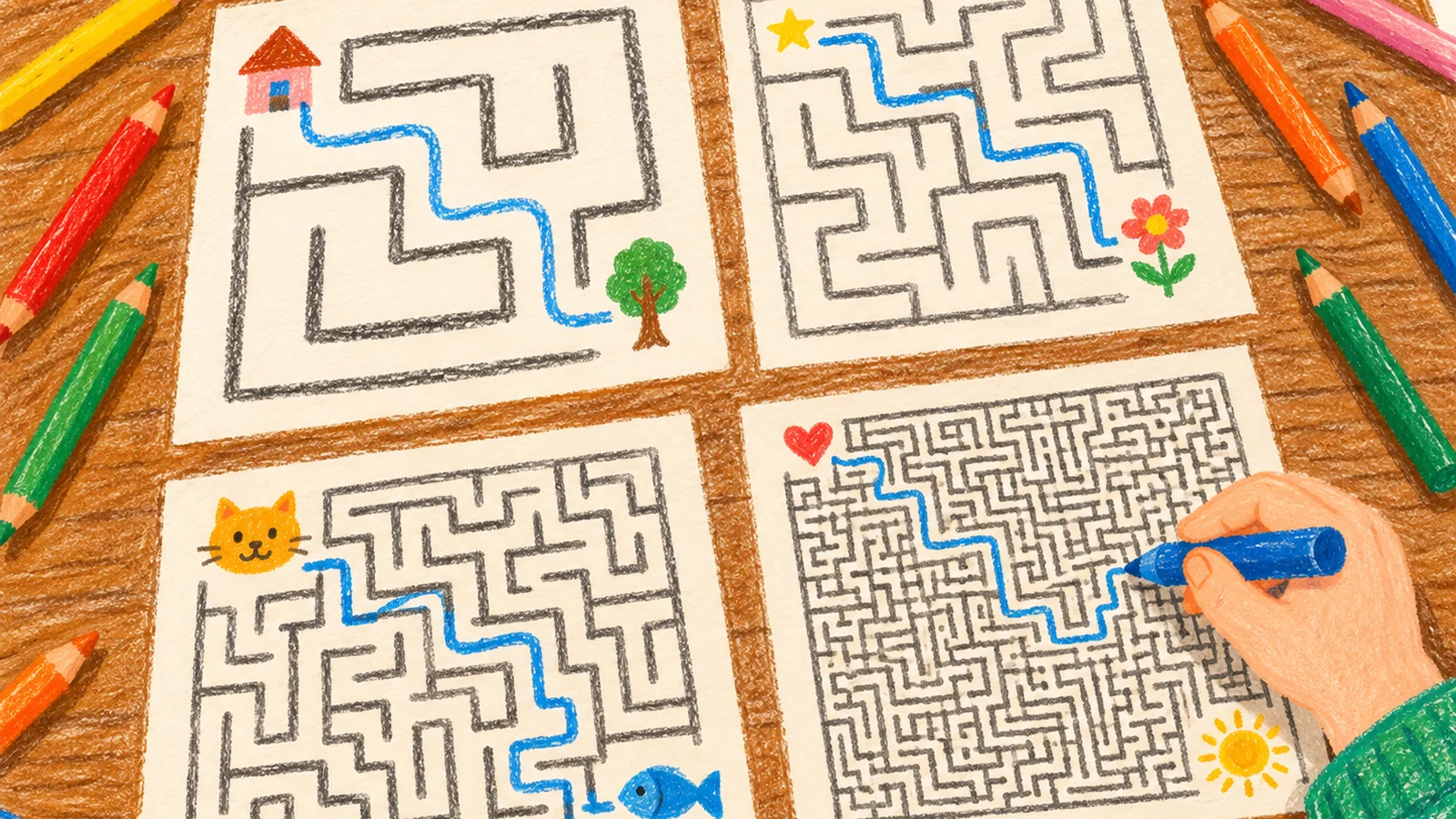
Mazes for kids work best when the paths match your child's age and experience. Start with an easy 8 by 10 maze at age 4, move to medium mazes around 6, try hard mazes at 8, and introduce expert mazes around 10.
But age is only a starting point. Some preschoolers can solve winding paths quickly, while older kids may still need help spotting dead ends. If you're printing mazes for home, a classroom, or a rainy afternoon, a few small changes can make the difference between a child giving up and asking for another page.
Which maze size works best at each age?
For a 4-year-old, I'd start with a maze that has roughly 8 rows and 10 columns. Keep the paths wide, use one obvious entrance and exit, and avoid too many branches. A maze with five decisions is a much friendlier introduction than one with twenty.
At age 6, try a medium maze with around 10 by 12 cells. Children who already enjoy puzzles might handle 12 by 15. Add longer routes and several dead ends, but leave enough space for a pencil to move comfortably.
By age 8, many children are ready for hard mazes around 15 by 20 cells. At 10, an experienced solver can try 20 by 25 or larger, with narrower paths and plenty of false turns. These are practical starting sizes, not fixed milestones. The actual difficulty depends on the number of branches, the length of the solution, and how similar the paths look.
A useful test is whether your child can finish with a little thought rather than constant help. If frustration arrives before the halfway point, choose a smaller maze next time.
- Age 4: Easy, roughly 8 by 10 cells, wide paths and few choices.
- Age 6: Medium, roughly 10 by 12 cells, with several dead ends.
- Age 8: Hard, roughly 15 by 20 cells, with longer paths and more branches.
- Age 10: Expert, roughly 20 by 25 cells or larger, with narrower routes and false turns.
Teach the finger-first rule before using a pencil
The first trick I teach is simple: trace the route with a finger before drawing anything. Put the page flat, find the starting point, and ask your child to move one finger along the path. If they reach a wall, they can back up without leaving pencil marks.
This matters most with easy mazes for preschoolers. A child who is still learning to control a crayon may understand the route but struggle to draw inside a narrow corridor. Finger tracing lets them practice the puzzle without fighting the pencil.
Once they find a route, hand over a chunky crayon or pencil and ask them to trace it again. You can find suitable starting puzzles in Easy mazes for preschoolers at /easy-mazes-for-kids/. Begin with one page and give your child time to inspect the whole picture.
Got a child who keeps rushing into the first opening? Ask them to stop at each fork and point toward the next possible path. A three-second pause is often enough to spot a wall ahead.
Try solving backwards when the maze gets confusing
Some mazes look difficult from the entrance but become easier when you start at the finish. Ask your child to place a finger on the exit and trace backwards toward the beginning. Sometimes the last stretch has fewer choices, which makes the route easier to see.
For a 6-year-old, try having them explore from both ends without drawing a line. They can work forward from the start, then switch to the exit when they get stuck. Once the two explored routes meet, they have a path to follow.
You can also teach a second trick: look a little farther down each branch before choosing it. Does the corridor close after two turns? Then skip it. This is easier on a medium maze than a crowded expert puzzle, where paths may be too long to inspect at a glance.
I wouldn't teach every trick in one sitting. Finger tracing first, backwards solving on another day. Give your child time to find a favorite method.
Why dead ends are good for children
Dead ends aren't mistakes in a maze. They're where the thinking happens. When a route closes, your child has to notice what went wrong, return to an earlier turn, and choose another path.
Suppose your child follows a corridor that splits into two branches. The left branch ends at a wall, so they return and try the right one. That small correction gives them practice changing plans rather than repeating the same choice.
A maze also gives you a chance to talk about mistakes without making them personal. Instead of saying, 'That's wrong,' try, 'That path stops here. Where was the last turn?' Keep your voice matter-of-fact. There is no need to erase every wrong turn immediately.
For children around 8 who enjoy a tougher challenge, Hard mazes at /hard-mazes/ offer a way to practice dealing with extra branches. If a page causes tears or repeated guessing, put it aside. A smaller maze still gives your child useful practice.
Make maze practice a simple weekly routine
You don't need a long activity session to use printable mazes. I'd begin with 5 minutes, two or three days a week, especially for younger children. Older children who enjoy puzzles can spend 10 to 15 minutes on a harder page.
On Monday, give your child a maze they can probably finish alone. On Wednesday, introduce one new challenge, perhaps an extra branch or a slightly larger grid. On Friday, let them choose between two difficulty levels. Children often work longer when they get to pick the page.
Print two copies if siblings want to solve the same puzzle. One can trace with a finger while the other uses a crayon, then they can swap. There's no reason to turn it into a race, particularly if their ages or drawing skills differ.
Keep finished pages in a folder and write the date in a corner. After a few weeks, let your child retry a maze that previously took a lot of effort. They might notice a shortcut or solve it with fewer stops. That's a more useful comparison than racing another child.
For a steady supply of different layouts, use Printable mazes for kids at /printable-mazes/. Pick the next page based on how the last one went, not just the birthday on the calendar.
Use shaped mazes to make practice feel like play
A rectangular maze is easy to understand, but it isn't the only option. A maze shaped like a pumpkin, star, heart, or butterfly gives the activity a little personality. The route still needs to be clear, particularly for younger kids.
Holiday mazes can work well during classroom parties or at the kitchen table before a celebration. Try a pumpkin-shaped maze in October, a heart in February, or an egg-shaped maze in spring. Pair the theme with a drawing activity if your child finishes early.
For children who like recognizing shapes, Shape mazes at /shape-mazes/ are a natural next choice. You can ask, 'What shape is the maze?' before they start, then let them solve it without extra questions.
Watch out for decorative details that crowd the paths. A maze with a beautiful outline but tiny corridors may be harder than its difficulty label suggests. I would choose a plain, readable page over a busy one every time.
And if your child wants to make a maze instead of solving one, draw a large outline, add a start and finish, then build a route between them. Add a few false turns afterward. Let someone else try it, and see whether the path actually works.
Questions parents ask
What age can kids start doing mazes?
Many children can start trying very simple mazes around ages 3 to 4, especially with wide paths and finger tracing. Begin with just a few turns and help them find the entrance and exit.
Are mazes good for a child's brain?
Mazes give children practice with visual tracking, planning a route, and correcting a wrong turn. Drawing through the paths also gives them a chance to work on pencil control.
How do I help my child who keeps getting stuck on mazes?
Start with finger tracing and ask your child to look for the last fork before the dead end. If that doesn't help, try tracing backwards from the finish or switch to a maze with fewer branches.
More from the blog
All articles Dot to dot for preschoolers makes five minutes countSee how dot to dot pages help kids practice numbers, pencil control, and planning, with simple ways to choose the right page for each age.
 Scavenger hunt ideas for kids: 12 fun lists to tryTry 12 scavenger hunts for kids with ready-to-use lists for home, outside, holidays and parties, plus easy rules for preschoolers and older kids.
 80 trivia questions for kids with answers by topicTry 80 trivia questions for kids across eight fun topics, with answers included and simple rules for hosting a family or classroom quiz.